Showing posts with label Obama. Show all posts

Thursday, June 12, 2014

The Disintegration of Iraq Has Begun--William O. Beeman--New America Media


The Disintegration of Iraq Has Begun

New America Media, News Analysis, William Beeman, Posted: Jun 12, 2014
Iraq was a creation of the British following World War I out of disparate Ottoman provinces that had never had any coordinated existence. It is now on the verge of disintegration, thanks to the misguided policies of the American Bush/Cheney administration. President Obama is being pressured by his Republican critics to “do something” about this. But anything he does will only make matters worse.

The forces of the Islamic State of Iraq and Syria (ISIS) have now taken most of Northern Iraq and are inching toward Baghdad. The withdrawal of American troops from the country, and the inexperience of the Iraqi national army have left the field wide open for this takeover. Since troop numbers for ISIS are very small—around 1000 by some estimates—their rapid advance seems incomprehensible, until one considers the ethnic makeup of the territory.

ISIS is a mature Sunni Muslim movement started in 2000. The government of Iraq and its troops are largely Shi’a Muslim. The territories now conquered by ISIS are also Sunni. There is only one conclusion that fits the facts of the success of the ISIS conquest: The Sunni residents of Northern Iraq are aiding ISIS in the takeover. Thus the ISIS “conquest” is not that at all—it is rather a full-scale revolt of the Sunni population against the Shi’a government.

The seeds for these events were sown a full century ago in the creation of the State of Iraq by the British. The British essentially created an artificial state that was doomed to self-destruct. The surprise is not that it is falling apart; it is rather that it has lasted this long.

After World War I, the British had two goals regarding Iraq. They wanted the oil riches of the Ottoman province of Mosul, and they wanted the port of Basra as a depot for the export of that oil and the transport of goods from India to Europe via the railway they also built. Baghdad, the historical metropolis that lay between these two on the great navigable rivers, the Tigris and the Euphrates, was the natural capital of the new nation.

The British were not at all concerned about the ethnic communities of the new nation. They were mere inconveniences controlled by force to allow the colonial occupation to continue to extract wealth. The Kurds, sitting on the oilfields, were traitorously cheated out of their own independent state. The majority Shi’a in and around Basra were deprived of any but a token role in governance, and the Sunni kings in Baghdad—natives of Arabia and installed by the British—were dominated by the British Embassy and army until a revolution removed them all in 1958.

Keeping the nation together after that point was a formidable task. After years of internal strife the nation devolved into a military dictatorship under Saddam Hussein whose ruthless authoritarian tactics suppressed all revolt on the part of the individual ethnic communities.

All of this changed in 2003 with the American invasion of Iraq under George W. Bush. The first American invasion by George H.W. Bush had left the government intact, but the 2003 invasion destroyed Saddam’s rule and left the nation’s factions exposed like an open sore. The Shi’a majority established a government, but like in the Kingdom of Iraq, the new government was dependent on the American military to maintain the order they needed to govern. Moreover, the Shi’a leaders, fuming with rage at decades of mistreatment wanted revenge. They clamped down on the Sunnis, depriving them of any power in the new government and engaging in their own repression of Sunni majority regions. This of course created even more enmity between the communities.

Now, with the withdrawal of the United States from Iraq, the wounds are open once again, and there is nothing available to stench the flow of blood. The United States situation presents a terrible dilemma for President Obama. He is being called upon to do something to stop ISIS, as if this organization was an invading force that could be air-bombed and stopped. In fact, ISIS is simply the vanguard of a popular resistance against the Baghdad government. Moreover, Iranian troops have been enlisted to aid the Iraqi army in countering these forces.

So the pressure on President Obama from his Republican critics to provide military support against ISIS is misguided. If the President acquiesced, he would be attacking a popular revolt. The justification for this would be that the United States is actually attacking the seemingly greater enemy—fundamentalist Sunnis who are already furious at the United States. However, this distinction is utterly lost on the Sunni residents of Northern Iraq who have been caught in military crossfire for more than a decade and already see the United States as the enemy.

Added to this is the fact that Iranian troops have been enlisted to aid the Iraqi army. Thus the United States, in attacking ISIS would actually be making common cause with Iran—which Washington has labeled “the chief State supporter of terrorism.” The irony is truly staggering.

So at this point President Obama is trapped. Opposing ISIS is in the interests of the United States. Allying with Iran is political poison for the Obama administration. Doing nothing will result in the disintegration of Iraq. Right now, disintegration seems to be the path that the United States and the Iraqis are following.

Can this terrible state of affairs be calmed? Perhaps. The United States handled the insurgence in the Sunni communities by bribing the leaders of the resistance with cash and promises of leadership positions. The cash was given, but the leadership positions never emerged. That is still a strategy that could work in the short run. In the long run if Iraq is to hold together, there must be a serious effort at power-sharing at the national level.

Failing that, the nation will certainly split apart. There is nothing more to hold it together.

William O. Beeman is Professor and Chair of the Department of Anthropology at the University of Minnesota. He has conducted research in the Middle East for more than 40 years

Sunday, September 08, 2013

War with Syria Would Fulfill Neoconservative Plan for Middle East Regime Change (Beeman--New America Media)

http://newamericamedia.org/2013/09/war-with-syria-would-fulfill-neoconservative-plan-for-middle-east-regime-change.php#

War with Syria Would Fulfill Neoconservative Plan for Middle East Regime Change

War with Syria Would Fulfill Neoconservative Plan for Middle East Regime Change

New America Media, Commentary, William Beeman, Posted: Sep 08, 2013


There is great division of opinion regarding potential U.S. military action in Syria. However, one group is ecstatic over President Obama’s endorsement of a military attack on Damascus. These are the Neconservatives who dominated the George W. Bush administration, and who still hold tremendous influence in Washington. An attack on Syria would be one step in fulfilling “stage two” of a longstanding neoconservative plan to bring about regime change throughout the Middle East in three stages: Iraq, Syria and finally Iran.

The pattern for this plan has been to wait for an event that can be sold to the world public as justification for military attack, and then to push forward, pressuring the military and government officials to move forward with the next stage of regime change.

President Obama is, perhaps unwittingly, fulfilling this plan, conceived in 1996 by an informal organization, the Study Group on a New Israeli Strategy Toward 2000, headed by Richard Pearle and including well-known neo-conservatives, Douglas Feith, Meyrav Wurmser, David Wurmser, Robert Loewenberg, Charles Fairbanks, Jr. and James Colbert. All are connected with organizations favoring right-wing extremist Israeli policies toward Palestinians and other Middle East nations. The Study Group plan, titled “A Clean Break: A New Strategy for Securing the Realm” was prepared for Israeli Prime Minister, Benjamin Netanyahu. The “clean break” refers to their advice that Israel break from the 1993 Oslo peace accords.

The 1996 plan explicitly calls for attacks on Iraq, Syria and eventually Iran. It states: "Israel can shape its strategic environment . . . by weakening, containing, and even rolling back Syria. This effort can focus on removing Saddam Hussein from power in Iraq — an important Israeli strategic objective in its own right — as a means of foiling Syria’s regional ambitions."

Many of the same figures carried this plan forward two years later under another rubric, The Project for the New American Century (PNAC) founded by William Kristol and Robert Kagan. In a letter to President Clinton and House Speaker Gingrich in 1998, the members of the PNAC, including Kristol, Paul Wolfowitz, Donald Rumsfeld and Robert Zoellick called for the removal of Saddam Hussein, carrying out the first stage of the agenda of the “Clean Break” plan.

Once George W. Bush was elected president, many of these figures took up prominent positions within his administration. Following the tragic destruction of the Twin Towers in New York and the attack on the Pentagon on September 11, 2001, the removal of Saddam Hussein became a policy objective for the United States.

The PNAC wrote a letter to President Bush in 2001 stating: “...even if evidence does not link Iraq directly to the attack, any strategy aiming at the eradication of terrorism and its sponsors must include a determined effort to remove Saddam Hussein from power in Iraq.”

It was at this time that Iran came more clearly into focus for the neoconservatives. The theory they promulgated was that Iran was the prime mover in all anti-Israeli activity in the region through Iran’s purported support for Lebanese Hezbollah and Palestinian Hamas. Syria was seen as complicit in this, and was regularly identified as a “client state” for Iran. However, neither legislators nor the public could be incited by this theory, for which there was, and continues to be, no credible evidence.

In 2003, the neoconservatives, working through right-wing think tanks such as the Washington Institute for Near East Policy (WINEP), the American Enterprise Institute (AEI) and the American Israeli Public Affairs Committee (AIPAC) were able to convince the Bush administration that Iran’s 40 year old nuclear energy program was really a plot to develop nuclear weapons to be used against Israel. This theory eventually became accepted as gospel in Washington, notwithstanding that American and International intelligence agencies asserted there was no evidence of an Iranian nuclear weapons program. However, based on this baseless assertion, these same players called for military action against Iran.

Following the “Arab Spring” popular revolts against standing regimes in the Middle East the longstanding tension between the Sunni Muslim majority and the Alawite ruling minority in Syria exploded in resistance against Syrian ruler Bashar Al-Assad. This conflict had been festering for two generations. In 1982, armed resistance from the Sunni population resulted in a massacre in the city of Hama under orders from Hafiz al-Assad, Bashar’s father. Bashar retaliated to the more recent revolt with unprecedented cruelty, and has been accused of using chemical weapons against Syrian rebels. Whatever the United States or other nations might do to remove the Assad regime, the civil war there will continue unabated.

However, neoconservatives have seized on this more recent revolt against the Assad government as justification for military action to carry out regime change there, but not just because the Assad regime is objectionable, but rather because in an attack on Syria they see an opportunity to strike a crippling blow against Iran. As conservative New York Times columnist David Brooks stated on the PBS News Hour on September 6, “this isn’t really about Syria. . . . the real issue is the broader credibility of the President, the international credibility of the United States, especially vis-à-vis Iran. This is really about Iran more than Syria.”

Brooks’ widely held view is a miscalculation. Even if the Assad regime is removed from power, Iran will not be significantly damaged in its foreign, nuclear or economic policy.

A quick examination of all of these efforts—the pretext based on the 9/11 tragedy for ousting Saddam Hussein, weak justification for U.S. involvement in a longstanding and ongoing civil war in Syria, and the claim that Iran is not only directing all anti-Israeli action in the Middle East, but is also a nuclear threat show that the neoconservative agenda is a tissue of fantasy designed to convince the world, episode by episode, to completely reshape the region with U.S. military firepower.

Americans should not be listening to these neoconservative voices. They have been responsible for a debilitating and useless conflict in Iraq already. Their “advice” to President Obama and his administration will only drag the United States into another useless and debilitating conflict in the Middle East that will accomplish nothing, and will exacerbate violence rather than bringing the world closer to peaceful resolution of the tensions in the region.

William O. Beeman is Professor of Anthropology at the University of Minnesota, and Visiting Professor at Stanford University. He has worked in the Middle East for more than 40 years.

Saturday, August 03, 2013

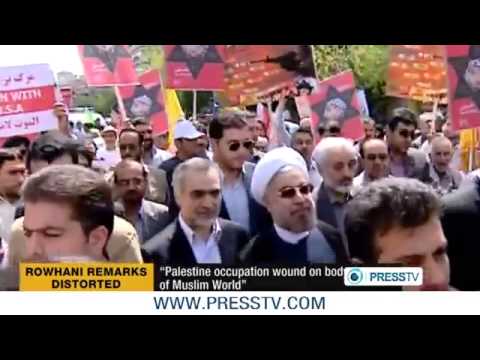
Video Shows Iran’s President-Elect Was Misquoted on Israel


Commentary by William O. Beeman: The fact that the New York Times jumped to print the incorrect information about Mr. Rouhani's comments is testament to the prejudicial reporting that has persisted in writing about Iran. The initial incorrect report appeared on the Times front page. The Lede is a pale correction. Mr. Rouhani's remarks about the state of affairs surrounding the city of Jerusalem, which was the focus of his remarks. There is no mention of Israel, only of "coercion" and "oppression" which are the "sores" (zakhm) that have persisted for the Muslim world. Who could take issue with that? Clearly the New York Times and Prime Minister Netanyahu, who twisted these remarks into some imagined attack on Israel.

Here is what Barak Obama said about Israel:

"But what I think is that this constant wound, that this constant sore, does infect all of our foreign policy. The lack of a resolution to this problem provides an excuse for anti-American militant jihadists to engage in inexcusable actions, and so we have a national-security interest in solving this, and I also believe that Israel has a security interest in solving this because I believe that the status quo is unsustainable." <http://www.theatlantic.com/international/archive/2008/05/obama-on-zionism-and-hamas/8318/>

http://thelede.blogs.nytimes.com/2013/08/02/video-shows-irans-president-elect-was-misquoted-on-israel/

Video Shows Iran’s President-Elect Was Misquoted on Israel

A video report from Iran’s state-owned Press TV included subtitled remarks by President-elect Hassan Rouhani that were misreported by other Iranian news agencies on Friday.

Last Updated, 6:46 p.m. | As my colleague Thomas Erdbrink reports from Tehran, Iran’s state media scrambled on Friday to correct comments wrongly attributed to the country’s president-elect, Hassan Rouhani, after he was incorrectly quoted calling Israel “a sore which must be removed.”
Press TV, the English-language arm of Iran’s state broadcaster, subtitled Mr. Rouhani’s actual remarks, made to a reporter during the Islamic republic’s annual march for Quds, the Arabic name for Jerusalem. The video shows that the cleric did not mention Israel by name or call for its elimination, but did compare “the shadow of the occupation of the holy land of Palestine and the dear Quds,” to a “wound” or “sore” that “has been sitting on the body of the Islamic world for many years.”
Those remarks were still disturbing to Israelis, since they hewed to the Iranian government line that the entire state of Israel is occupied Palestinian territory. A longer clip of the state television broadcast showed Mr. Rouhani smiling and waving in the parade as chants of “Death to Israel” echoed in the background.
Video from Iranian state television of senior clerics marching in the annual Quds Day parade in Tehran on Friday.

That report also showed other senior figures marching, including the former president Ali Akbar Hashemi Rafsanjani. According to Shiva Balaghi, an Iranian-American cultural historian, Mr. Rafsanjani explained as he marched that the point of the annual Quds Day rally was to encourage Palestinians. “When they see this support,” he said, “they will become hopeful.”
Arash Karami, a journalist who blogs about the Iranian media, noted that two semi-official news agencies that initially misreported Mr. Rouhani’s remarks, subsequently corrected their reports in articles headlined: “The Occupation of Palestine Is a Wound on the Body of the Islamic World.”
International news organizations that had relied on the initial, flawed reports from Iran were forced to explain the error later in the day. Rana Rahimpour of the BBC’s Persian service explained what happened in an appearance on BBC World News.
An on-air correction from BBC News, explaining that Iran’s president had been misquoted.

After the video showed that Iran’s incoming president had been misquoted, a spokesman for Prime Minister Benjamin Netanyahu said that the Israeli leader stood by his initial response, in which he said:
Rouhani’s true face has been revealed earlier than expected. Even if they will now rush to deny his remarks, this is what the man thinks and this is the plan of the Iranian regime. These remarks by President Rouhani must rouse the world from the illusion that part of it has been caught up in since the Iranian elections. The president there has changed but the goal of the regime has not: To achieve nuclear weapons in order to threaten Israel, the Middle East and the peace and security of the entire world. A country that threatens the destruction of the State of Israel must not be allowed to possess weapons of mass destruction.
That comment remains on the prime minister’s Facebook page, still explained as his response to Mr. Rouhani’s “remarks in which he was cited as saying that Israel ‘has been a wound on the body of the Islamic world for years and should be removed.’”
Hours later, the prime minister’s official spokesman to the Arab media, Ofir Gendelman, drew attention on Twitter to an Arabic translation of Mr. Netanyahu’s rejoinder without mentioning that there was no evidence the comment that prompted the response was ever made.
There was evidence of some confusion in the Israeli response, though, since Golnaz Esfandiari, a reporter who blogs on Iran for Radio Free Europe/Radio Liberty, noticed that part of the statement initially posted on Mr. Netanyahu’s personal Twitter feed was deleted shortly after she replied to it.