Monday, October 25, 2010

Beeman--Iran's Involvement in Iraq--Wikileaks Documents don't prove a thing

Michael R. Gordon and Andrew W. Lehren wrote a long front-page article in The New York Times on Saturday, October 22 entitled "Leaked Reports Detail Iran’s Aid for Iraqi Militias"
<http://www.nytimes.com/2010/10/23/world/middleeast/23iran.html?_r=1&scp=1&sq=Michael%20Gordon%20Iran%20Iraq&st=cse>

This article is based on documents produced by the whistleblower site, Wikileaks.

Readers should be deeply skeptical of claims that the the NY Times reporting on Iran's involvement in Iraq based on the Wikileaks documents constitutes some kind of smoking gun about Iran's involvement in attacks on the U.S. military, or, actually, that the reporting constitutes anything new at all.

These Wikileaked documents are all internal U.S. military dispatches. They merely report what the military believes to be true. In fact, everything reported in the Times by Gordon and Lehren--all the stuff about missiles, EFT's and Hezbollah-- have already been claimed by the military over the years, and dutifully reported by the Times, sometimes with "enhancements" from the writers, and others such as Michael Slackman.  It should be noted that when the military tried to show the captured equipment, they couldn't trace even one piece definitively to Iran. Having a leaked memo expressing the military's belief that it this equipment was Iranian without further proof doesn't make this any more believable. The Times had the gall to show a picture of the non-conclusive materiel along with their story as if now their claims would render the claims valid.

The only thing that is different in this report is that the Wikileaks documents give us the verbatim internal reports. Merely having them stated in this form doesn't constitute proof of the assertions. Indeed, Gordon and Lehren themselves point out that the claims can not be verified. They further pad their article with negative quotes about Iran from U.S. Ambassador to Iraq, Christopher Crocker, unrelated to the Wikileaks documents, as if his speculations constituted better proof. Some commentators have been somehow impressed by these documents, but a close inspection shows that they provide no more proof than anyone had before.

The Times has much to report regarding this fantastic trove of documents, Why they chose to feature this story is obvious to me. They have made this story a running epic over the last seven years with no end of criticism. They now seem to be returning to the well with these documents, but the evidence is no more compelling for its repetition.


Tuesday, October 19, 2010

Franklin Lamb--"Isn't This One Fine View?" On the Road with Ahmadinejad in Lebanon

http://www.counterpunch.org/lamb10152010.htmlWeekend

EditionOctober 15 - 17, 2010

"Isn't This One Fine View?" On the Road with Ahmadinejad in Lebanon


By FRANKLIN LAMB

Commentary by William O. Beeman: President Ahmadinejad's enthusiastic welcome in Lebanon is a surprising and singular phenomenon. It will be analyzed for some time. The most astonishing aspect of it is the broad participation by the Lebanese community, transcending Shi'a/Sunni/Christian/Druze splits in the society.


Qana.

He came, he saw, he conquered.

As he watched the Iranian President blow kisses to cleaning workers at Beirut’s airport during his departure for Iran early this morning, a Lebanese Christian historian commented “This Persian’s glory at the moment is arguably greater than Caesar’s following Rome’s second conquest of Britain”.

And the Iranian president did indeed throw much more than a stone at US-Israel projects for Lebanon, perhaps energized by the adoring public he encountered. A grateful nation extended to Makmoud Ahmadinejad what one Bishop claimed was the greatest outpouring of popular support on the streets, all along this country’s sectarian divide, that the Republic of Lebanon has ever witnessed including the May 10, 1997 visit of Pope John Paul II.

An important reason for the outpouring of popular support was the quarter century of Iranian assistance to Lebanon for social projects, and for rebuilding much of Lebanon following the 1993, 1996 and 2006 Israeli aggressions. Massive aid that was detailed by Hezbollah’s Secretary-General in a recent speech and the cost of which is estimated to be in excess of one billion dollars.

Iran’s President is widely believed in the diplomatic community here to have promoted sectarian unity in Lebanon, calmed the current political atmosphere, and delivered on offers of more desperately needed economic projects via 17 bilateral agreements. A particularly appreciated offer throughout Lebanon is Iran’s major pledge of an electrical complex that will deliver 7 times Lebanon’s current power supply, which in 2010 still sees power cuts throughout Lebanon. The current deficiencies range from three hours to 12 hours daily power cuts everywhere in Lebanon plus total blackouts for days at a time in some areas. Iran’s President is widely believed to have achieved a major advancement for Lebanese stability, sovereignty, and independence.

The throngs were cheering, waving, and shouting their admiration. Local media used descriptive words like “rock star, rapturous, massive affection,” to describe his reception.

Wretched Palestinian refugees, tightly shoe horned into Lebanon’s squalid UN camps, denied even the most elementary civil rights by an apathetic international community and some of the local sects, could be seen along the route. Many with eyes moistened, perhaps by Nakba memories and tears of hope for the early liberation of their sacred Palestine and the full exercise of their internationally mandated and inalienable Right of Return to their homes.

Refugees, plenty of them illegal, Iraqis, Afghans, Kurds and others, urging the expulsion of occupation forces from their countries and the restoration of their former lives waved and blew kisses. Lebanese domestic ‘guest/slave workers’ from Sri Lanka, Ethiopia, Sudan, Philippines, Bangladesh, and other countries could be seen in the crowds along with Syrian construction workers. Also a sprinkling of Stendhal “Le Rouge et le Noir” characters who, seeking secure advancement in life, have fixed themselves to one or the other, both requiring that they be seen publicly at such an important event.

Close to 750,000 people, or approximately one quarter of the total population of Lebanon,) of all ages and stations in life, appeared at the main road from Beirut’s airport and at other events during an intense two day frenetic series of appearances. Red, green and yellow rose petals, the colors of Iran’s flag, greeted Lebanon’s guest. Due to time constraints, some events for which much preparation had been made were “postponed”, including an “American Town Hall Meeting with President Ahmadinejad. ” It was to include 15 Americans currently in Lebanon as academics, business people, students, housewives, and NGO’s, in a much anticipated US political campaign type format with Iran’s President joining an informal dialogue with his interlocutors.

At Al Raya Athletic field in South Beirut, often used for popular Hezbollah events, an estimated 150, 000 people crowded onto just the main field boundaries, , one Hezbollah source reporting that it was the largest gathering inside the field ever seen. Thousands of other attendees spilled onto the side streets where huge TV screens has been set up and vendors hocked roasted ears of corn, boiled balila beans, kaak asrounye (baked bread with filling) ) various treats, including chips, cotton candy and soft drinks. Driving around the area on the mercifully cool autumn evening by motorbike, one could see thousands more gathered at several dozen Dahiyeh outdoor cafes and store front shops where families and friends gathered to watch on the proprietors’ outdoor TV screens. Some of the adults smoked arguila water pipes and little kids played, happy to be allowed to stay up late while teenagers appeared contented to get a day off from school and an evening without homework.

Lebanese and Iranian flags were fluttering everywhere without huge numbers of Hezbollah flags displayed in keeping with the message that this was an official state visit. President Ahmadinejad of Iran was invited by President Michel Suleiman of Lebanon on behalf of every Lebanese, including the majority of Lebanese who live in the Diaspora. Deployments of Suleiman’s Presidential guards were the ones seen to be providing security for Iran’s president with Hezbollah security largely out of site, except for occasional fleeting glimpse of Hezbollah sharpshooters in windows throughout the assembly area. They also surfaced quickly if a dispute or argument flared up in the packed crowds. In these few cases a representative of Hezbollah would apologize for the crowded conditions and ask for patience and understanding during the event.

At one stop near the blue line in South Lebanon he smiled broadly, winked to the media contingent and adoring villagers surrounding him and, gazing deep into occupied Palestine, as if posing for a Marlboro Country billboard advertisement, Iran’s charismatic President made many a heart flutter when he spoke softly, almost whispering to some villages, and with a twinkle in his eye, as if someone were eavesdropping: “Now isn’t this one fine view?”, as he discretely pointed. “I like it over there, don’t you?”

Almost everyone laughed at his joke.

A young lady wearing a full length black Chador (a women wearing one is called a ‘Chadori’ in Persian and Lebanese resistance culture) , with some of her school mates in tow who were volunteering as hostesses and Farsi, Arabic, and English interpreters, offered arriving American guests enthusiastic greetings: “Welcome to the Islamic Republic of Iran’s new border with Palestine!”

Almost everyone laughed at her joke.

Then, exuding an easy self confidence and speaking American accented English while obviously having a good time, the student noticed one seemingly horror struck humorless lady wearing a light brown business suit and heels who a security guy later confided was suspected of being a US Embassy plant. “Just teasing”, she assured the woman, as she offered her hand in friendship to the flinching guest who glared uneasily at the hostesses’ hand as if it held a dead rat or might bite hers. “Why are you Americans so serious”? the loquacious hostess smiled. “Do you agree Iran and America are destined to be good friends after our countries are finished with this problem?”, and she gestured with her head south toward Tel Aviv.

“Please tell me what do Americans think? I read a few days ago in preparation for my work today-I should not say work, it’s really fun- a report that ninety percent of Americans in a recent poll said they did not favor attacking Iran unless Iran attacks Israel first. This is very good news because I am sure Iran, unlike Israel’s record, will never be the first to start a war. Iran will retaliate naturally and that could mean World War III, but there will be no war involving Iran unless Iran, Syria, or Lebanon is attacked. We in the Resistance Alliance are ‘one for all and all for one’ but we really want to be friends with the American people.” And she offered the woman a small ribbon-tied, party wrapped, cellophane pouch with Iranian pistachios and candy attached to a small Iranian flag. “No thanks”, the American answered as she walked away.

The American Embassy warned Americans to avoid Ahmadinejad’s “provocative and potentially dangerous visit because the Lebanese government cannot protect US Citizens.” Jeffrey Feltman, the assistant secretary of State for Near Eastern affairs, complained to the pan-Arab Al-Hayat on 10/13/10: “Why is the Iranian president organizing activities that might spark tension? We are taking steps to lower tension while Ahmadinejad is doing the opposite.”

Nevertheless, there were plenty of Yanks in attendance at all of Ahmadinejad’s appearances.

During his Qana visit, the Hezbollah Parliamentary delegation, friends with many Americans here, must have tipped off the Iranian President that Americans were sitting near them. The reason for this hunch is that he could not have been more gracious, making frequently eye contact and touching his forehead as a greeting and salute and thanking them for coming. He assured the American guests that eventually Iran and America will be good friends and perhaps allies.

Shortly before the Iranian President’s 35 car convoy carrying his delegation and various Lebanese officials arrived at Qana, his fourth largest gathering, an Israeli Air Force MRPV circled lazily yet provocatively above the site of the 1996 Qana massacre. Some in the more than 15,000 person crowd pointed skyward, some kids squealing “Israel!”. From their experience, “Qanains” as Ali, who grew up in this village explained some locals call themselves, were able to give foreigners fairly precise details of the MRPV’s specs and capabilities. This Israeli provocation ended, according to a Hezbollah security source, when the MRPV’s controllers realized that a Resistance laser guided missile had locked on to the uninvited intruder. The same source divulged that Hezbollah did not intend to shoot it down and would only monitor the threat. This was because the Resistance did not want mar the Iranian Presidents tour. In addition, he explained, explained that Lebanon’s resistance wanted to maintain “tactical and strategic ambiguity” concerning its array of anti-aircraft weapons until the moment war comes.

Lebanon’s people, army and resistance ignored provocations from this country’s southern enemy, including assassination threats like the one made by the Nakba-denying Knesset member Aryeh Eldad , more blustering from Shimon Peres, Ehud Barak, and PM Netanyahu, the beefing up of Israeli forces along the blue line, efforts to crack Hezbollah communications and send SMS threats via hacked mobile phones, conducting a chorus of US officials in childish criticisms of the visit, and Israeli spokesmen like Mark Regev and political extremists in Congress issuing threats.

Israeli warplanes on Friday carried out intensive, mock air raids over south Lebanon as if to send the message, “He is gone but we are still here!” The state-run National News Agency said Israeli jets staged mock air raids at medium attitude over Nabatiyeh, Iqlim al-Tuffah, Marjayoun, Khiam and Arqoub. Another signature Israeli taunt during Iran’s Presidents visit was the launching of hundreds of blue and white balloons to catch the air current north to Bint Jbeil when Ahmadinejad was appearing. Some with insults written on them by children with magic markers and others allegedly smeared with human feces, the spreading of the latter being an IDF insult employed over the past 45 years of incursions into Lebanon and Palestine when during occupations of Lebanese and Palestinian homes some Israeli soldiers create what they call “poop art” on walls, mattresses and other surfaces.

Analysts will write about Iran’s Makmoud Ahmadinejad’s historic visit for months to come and what the visit means for the two countries, for the question of Palestine, strategic alignments in the region, and consequences for China, Russia and the wider international community.

A perhaps too early, road-weary, sleep-deprived photo snap of his visit’s effects would warrant the following brief and tentative evacuation, as Lebanon’s guest has just departed Beirut airport to return to his country. His midnight departure followed a visit at the Iranian Embassy with Hassan Nassrallah during which the Hezbollah Secretary-General gave the Iranian President an Israeli rifle taken from an Israeli soldier during the July 2006 war.

Ahmadinejad’s visit achieved more than a symbolic consecration of a new local and regional reality that encompasses a third way, separate from the US-Israel-Saudi or Syrian path. Some here think we are witnessing a new era of growing and uncompromising Resistance to Israel’s brutal occupation and ethnic cleansing of Palestine as well as America’s occupation and exploitation of Arab natural resources. Some analysts are speaking about a six member Axis of Resistance led by Iran and Turkey and including Iraq, Afghanistan, Syria, and Lebanon that is the rising regional power.

What seems quite evident is that Iran’s President and the large delegation of business people comprising his entourage have opened a new era of bilateral relations between the two countries. His positive personal and political connections with virtually all Lebanon’s leaders, including compliments from rightist Christian politicians including Samir Geagea, will likely lead to big joint economic projects, the Iranian arming of the Lebanese Armed Forces, and strategic political cooperation, starting now.

Franklin Lamb is doing research in Lebanon and can be reached at fplamb@gmail.com

Saturday, September 25, 2010

My Dinner with President Ahmadinejad of Iran--Beeman

Dinner with President Ahmadinejad of Iran
William O. Beeman 
 
I was at an intimate dinner with Iranian President Ahmadinejad (and 57 others!) on Wednesday, September 22 at the Warwick Hotel in New York. We had an excellent Persian meal without the President being present (perhaps to meet the objection some had about "breaking bread" with him). Dinner was followed by a question and answer session in an adjacent room. The guests were largely public policy specialists, ex-ambassadors and a smattering of academics, a few of whom, including me, who spoke Persian because they were Iranian-American or because they had bothered to learn the language.
 
President Ahmandinejad is a fiery and controversial speaker in public, but in private he is a polished and polite conversationalist, and a highly skillful rhetorician. He manages to combine an erudite vocabulary with an informal, highly conversational verbal style. He answers questions even in a forum like this as if he was having an intimate chat with his interlocutors. This doesn't mean that he is any less controversial. He has pat answers for nearly every predictable question. Asked about executions in Iran, he points to the incipient execution of a woman in Virginia (which took place late last week after the dinner). When asked about nuclear weapons he says, "Announcing that you want nuclear weapons is to announce that you are a murderer. What other purpose is there for having nuclear weapons than to murder people." Asked about the judiciary, he points out that it isn't under his control and that in the U.S. and other nations, presidents often disagree with the decisions of the independent courts. 
 
Ultimately however, I was disappointed with the event. President Ahmadinejad extended the time originally allocated for questions and answers by 45 minutes. His patience with the assembled body was notable. However, the extra time was wasted. With few exceptions the vast bulk of the questions were really variations of each other--and all about Iran's nuclear program. This was disappointing because President Ahmadinejad had been answering questions from the press almost exclusively about this issue for two days. A simple Google search would have yielded up virtually every single answer he gave to those assembled at dinner.

The golden opportunity to engage President Ahmadinejad on a wider variety of issues--human rights, Afghanistan, Iraq, the environment, drug trafficking, trade policy, relations with India and China, and on and on was totally wasted in the obsession with the nuclear issue. At times I got the feeling that the assembled academics, ambassadors and policy specialists were trying to play "gotcha journalism" as if asking the same question over and over again in slightly different language was going to trap the President in to making some kind of verbal mistake. His line on the nuclear issue is by now finely honed, and he is quite practiced under fire. Any hope that he would break rank on this topic should have been dispelled in the first ten minutes. One of my companions snuck out early, saying "My God, this repetition is like water torture." I don't want to be mean spirited, but this was a sad showing from some of the finest minds in the country who somehow couldn't break away from this one-note theme.

But the food was superb.

Sunday, September 19, 2010

Beeman discusses relationship between US, Iran (Grinnell College--Scarlet & Black)


September 17th, 2010 | By | Section: News

On Thursday Sept. 16, William Beeman visited Grinnell College and gave a lecture entitled “Iran Is Not What You Think It Is.” Beeman is a specialist in Middle East Studies, Japanese Studies, Central Asian Studies, Linguistics and Performance Studies. He is currently a professor and Chair of Anthropology at the University of Minnesota while continuing a reputable musical career as an opera singer. Beeman has published, among other works, “The Great Satan vs. The Mad Mullahs: How the United States and Iran Demonize Each Other,” “Language, Status, and Power in Iran” and “The Third Line: The Opera Performer as Interpreter.”
He proclaims views on Iran that are contrary to commonly held misconceptions­—although he is a strong critic against Iran’s human rights record. In my interview with him, he shared with me a history of Iranian-American relations.
Beeman Convo
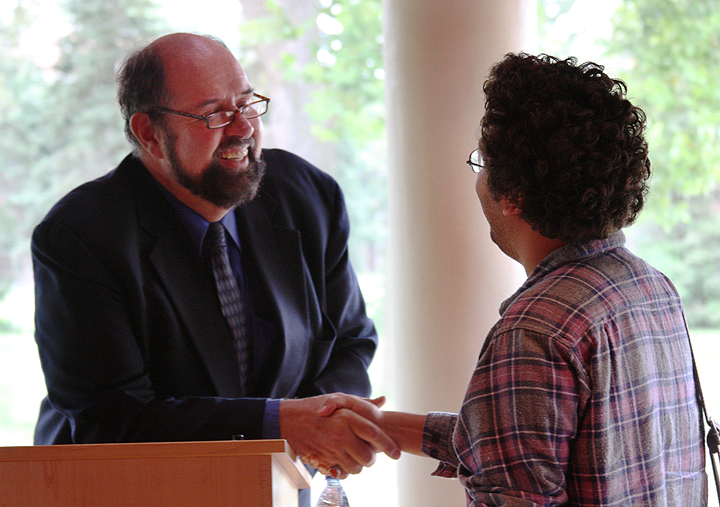
William Beeman shaking hands - Radka Slamova
Q: What is public perception of Iran in America? Why do you disagree with it?
A: I think people see Iran as, it’s been characterized by a lot of people as a medieval backward country that’s ruled by repressive religious forces, and the picture also paints Iran as this very dark, gloomy place. And this is, you know, I didn’t say this explicitly in the talk, but the first thing you want to dispel is this notion. Because most Iranians live with economic and political difficulty, but for the most part the Iranians live a very happy life.
The idea, too, that the place is ruled by mullahs is wrong. During the time when Ayatollah Khomeini was established as the spiritual leader, yes indeed, they put a lot of clerics in positions of authority. But over the years they’ve proven to be not very good managers. … They’ve gradually been replaced by people who really knew what they were doing. So even in government, maybe 25 percent are still bona fide clerics, but the balance of the government is all now secular individuals, or people who stopped pretending that they’re clerics.
And getting to be a high-ranked cleric is also, I should say, not necessarily a guarantee that you’re going to be conservative. And what you find is that you go to the theological schools in the city of Qom. It’s a big capital with theological training, and some of those clerics, first of all they are just so smart, they have the equivalent of a Ph.D. in philosophy, and of course they know Arabic and they are skilled in argumentation. And many of them are very, very liberal, and very radical, and they also feel that they have the right to come out and just flatly criticize the government, which they do on a regular basis. So being a mullah, so to speak, is not a guarantee that you’re going to be conservative.
So both of those stereotypes that mullahs run the government is not correct, and the stereotype that mullahs are very conservative is not correct.
Q: What is the root of strained relations between Iran and America?
A: Well there are two sides to it. There are Iran’s problems with the United States. And these go way back. In Iranian thinking, the United States is an extension of Great Britain, and in the 19th century, Great Britain and Russia more or less divided up the country into spheres of influence, and the British had enormous influence over Iranian politics and the Iranian government. … In 1952, the Prime Minister then, Muhammad Musaddiq nationalized the Iranian oil company. The British were furious about the nationalization of oil, and the United States was afraid that Musaddiq was creating an unstable situation, so the U.S. staged a coup and brought the Shah back into power and deposed of Musaddiq. This was the first time the United States had acted really directly to deal with Iranian internal affairs. Then gradually over time the United States developed commercial relations with the Shah…The U.S. sold arms to Iran, lots of them, extensively for the defense of the country, but the Shah more or less used the increased military expenditure to develop a very strong defense force that also repressed the population of the country. So gradually there was opposition to the Shah because of his repressive tendencies, [and this was] also directed towards the United States for their support of the Shah…Then when the revolution finally came in ’78-’79, the United States made the terrible mistake of admitting the Shah to the United States for medical treatment. This was a big surprise to the Iranians, they didn’t know he was sick. And when they’d heard he had cancer and he was going to the U.S., they thought “uh oh, here we go again. They deposed the government in 1952 and restored the Shah, and now they’re bringing the Shah to the United States to make plans to depose the government again.” So they wanted to send their own doctors to New York to examine him to see if he really had cancer because they didn’t believe it. And then the U.S. refused. And that was the thing that touched off the takeover of the American embassy. The American embassy was taken over then, and many people in Washington view this as the most awful insult that has ever been leveled against the Unites States.
So the United States started to have trouble, serious trouble, at the time of the hostage crisis. The U.S. broke off diplomatic relations at that time with Iran and they’ve never restored them. Gradually, the U.S. imposed economic sanctions upon Iran, it’s not clear why …but these sanctions were renewed under Bill Clinton, and then finally under George W. Bush we had a whole neoconservative agenda that had been cooked up during the 1990s to affect regime change in all of the countries in the Middle East and get rid of the Iranian government.
And the U.S. tries to find ways to make up an excuse for attacking Iran that would be plausible to the American public. So once again they renewed the idea that Iran was supporting terrorists worldwide. And then they claimed that Iran was attacking the U.S. through proxies in Iraq. And finally they hit on this nuclear idea, as a justification for attacking Iran. So you can see that there’s a lot of bad blood between the two nations. And untangling 30 years of hostility is really, really tough. And a lot of it is actually quite emotional, not even substantive.
In point of fact, Iran hasn’t done anything to the United States, not anything, they haven’t done anything. I mean they kicked out the Shah, but it was their Shah. The charge that they were attacking the U.S. military in Iraq turned out to be completely unsubstantiated. They haven’t attacked Israel—they haven’t done anything to us. And yet the United States is still claiming that they are the most dangerous people in the world, the most dangerous nation on Earth. And Iran can point to several things that the United States has done to Iran.
Also what’s happened in the last ten years is that US-Iranian relations, they weren’t very good, but they were separate from U.S.-Israeli relations. The last decade, they’ve become united. And there’s a kind of formula—if you’re soft on Iran or friendly towards Iran, then you’re an enemy to Israel. It’s kind of amazing because we really should be pursuing separate tracks in my way of thinking. This affects American political life, because nobody, no politician can come out and say not even anything positive, or they can’t even say we should rethink our dealings with Iran—because then they get attacked by people who say they’re not supporting Israel, because in order to be a friend of Israel they have to be an implacable enemy of Iran.
Anyway, I know that sounds long, but it’s kind of a short litany of these grievances between the two.

Saturday, September 18, 2010

Reality check: Iran is not a nuclear threat--Christian Science Monitor

http://www.csmonitor.com/Commentary/Opinion/2010/0917/Reality-check-Iran-is-not-a-nuclear-threat

The Christian Science Monitor - CSMonitor.com

Reality check: Iran is not a nuclear threat

Forget the neoconservative hype. The facts show Iran is not and has not been a nuclear threat to either the United States or Israel.
By Scott Horton
posted September 17, 2010 at 12:42 pm EDT
Comment by William O. Beeman:  Many of us have been trying to get this message across to the American public since 2003. The claim that Iran was making nuclear weapons was an excuse promulgated by the neoconservatives of the Bush administration to make attacking Iran acceptable to the U.S. body politic. Sadly, though there is ABSOLUTELY NO PROOF that an Iranian nuclear weapons program exists, it has now been presented so often that most Americans believe it to be true. This is a sad commentary both on our political life and on the American media. Please read and forward this piece widely.

Los Angeles —
Politicians, lobbyists, and propagandists have spent nearly two decades pushing the lie that Iran poses a nuclear weapons threat to the United States and Israel. After a brief respite in the intensity of the wolf cries over the past two years, the neoconservative movement has decided to relaunch the “Must Bomb Iran” brand.
The fact that Iran is not and has not been a nuclear threat to either nation is rendered irrelevant by a narrative of universal “concern” about its nuclear program.

US media distortions

In mid-August, for example, after The New York Times quite uncharacteristically ran a piece diminishing the supposed danger of Iranian nukes, the story was misrepresented in newspapers and on TV stations across the country in the most frightening terms. As MSNBC’s news reader put it that afternoon: “Intelligence sources say Iran is only one year away from a nuclear bomb!”
On August 13, on Fox News, former US ambassador to the UN John Bolton implicitly urged Israel to attack Iran’s new light-water reactor at Bushehr before it began “functioning,” the implication being that the reactor represented some sort of dire threat. But the facts are not on Mr. Bolton’s side. The Bushehr reactor is not useful for producing weapons-grade plutonium, and the Russians have a deal to keep all the waste themselves.
On September 6, the International Atomic Energy Agency (IAEA) released a new paper on the implementation of Iran’s Safeguards Agreement which reported that the agency has “continued to verify the non-diversion of declared nuclear material in Iran to any military or other special purpose.”
Yet despite the IAEA report and clear assertions to the contrary, news articles that followed were dishonest to the extreme, interpreting this clean bill of health as just another wisp of smoke indicating nuclear fire in a horrifying near-future.
A Washington Post article published the very same day led the way with the aggressive and misleading headline “UN Report: Iran stockpiling nuclear materials,” “shorthanding” the facts right out of the narrative. The facts are that Iran’s terrifying nuclear “stockpile” is a small amount of uranium enriched to industrial grade levels for use in its domestic energy and medical isotope programs, all of it “safeguarded” by the IAEA.

More sensational claims

If the smokescreen wasn’t thick enough, late last week a group of Marxist holy warrior exiles called the Mujahadeen-e-Khalq, working with the very same neoconservatives who sponsored Ahmad Chalabi’s Iraqi National Congress – which manufactured so much of the propaganda that convinced the American people to support the invasion of that country – accused the Iranian government of building a secret nuclear enrichment facility buried deep in tunnels near Qazvin.
Headlines once again blared in total negligence and without verification that here indeed was, an official told Fox News, proof that Iran has a “hidden, secret nuclear weapons program.’” TV news anchors on every channel furiously mopped sweat from their brows, hearts-a-tremor. When will the forces of good rise to stop this evil?!
Yet even US officials quickly admitted that they’ve known about these tunnels for years. “[T]here’s no reason at this point to think it’s nuclear,” one US official said – a quote that appeared in Fox’s article, but only after five paragraphs of breathless allegations. All day long, top-of-the-hour news updates on TV and radio let the false impression stand.
IAEA inspectors have had open access to the gas conversion facility at Isfahan, the enrichment facility at Natanz, and the new lightwater reactor at Bushehr, as well as the secondary enrichment facility under construction at Qom.

An ignored clean bill of health

The September 6 IAEA report confirming for the zillionth time the non-diversion of nuclear material should be the last word on the subject until the next time they say the same thing: Iran, a long-time signatory of the Nuclear Non-Proliferation Treaty (NPT), is not in violation of its Safeguards Agreement.
So what’s all the hubbub about Iran’s “nuclear defiance” and “danger”?
The IAEA’s latest report does note that Iran has “not provided the necessary cooperation to permit the Agency to confirm that all nuclear material in Iran is in peaceful activities.” Indeed, the agency’s frequent mentions of Iran’s “lack of full cooperation” is a big reason why US media reports portray Iran in ominous terms.
But here, too, US media frequently miss the point. Never mind that 118 nations around the world have signed a statement criticizing the IAEA’s “peaceful activities” conclusion as a departure from standard verification language. More broadly, Iran’s “lack of full cooperation” by itself is an outcome of Western bullying and propaganda.

Real reason for lack of cooperation

The US and the UN, acting upon no legitimate authority whatsoever, have demanded that Iran submit to an Additional Protocol to the Safeguards Agreement, which would ban any further enrichment on Iranian soil, as well as demanded they submit to an endless regime of IAEA inspections and questioning, based mostly on the “alleged studies” documents, which several sources have said are forgeries posing as a pilfered laptop of a dead Iranian nuclear scientist.
These separate, UN Security Council-mandated investigations have even demanded blueprints for Shahab 3 missiles – a subject far removed from hexafluoride gas or any legitimate IAEA function. In 2003, Iran voluntarily agreed to the extra burden of the unratified Additional Protocol during “good faith negotiations” with the so-called “E-3,” Britain, France, and Germany, acting on behalf of the US. When those negotiations broke down, Iran withdrew in 2006.
With these details left out of the discussion, the impression is left that Iran is refusing to abide by international law, when in fact, it is completely within its NPT obligations.

An outrageous standard

Meanwhile, Washington continues to apply to Iran the outrageous standard it used in the run-up to the Iraq war: an unfriendly nation must “prove” it doesn’t have dangerous weapons or a secret program to make them – or potentially face military action.
“Proving a negative” is, to say the least, a difficult obligation to meet: You say you haven’t read Webster’s Dictionary cover to cover? Prove it!
The bottom line is that Iran is still within its unalienable rights to peaceful nuclear technology under the NPT and the Safeguards Agreement – a point even Tehran’s fiercest critics (grudgingly) acknowledge. The only issues it is defying are the illegitimate sanctions and demands of the US and UN, which themselves defy logic and sense.

Journalists’ ethical obligation

It is far past time for the members of the American media to get their act together and begin asking serious follow-up questions of the politicians, “experts,” and lobbyists they interview on the subject of Iran’s nuclear program.
Many of these same journalists still have the blood of hundreds of thousands of innocent Iraqis on their hands from the months they spent continuously and uncritically parroting the lies, half-truths, and distortions of agenda-driven Iraqi dissidents and their neocon champions who pushed us into the Iraq war.
Perhaps this is their shot at redemption.
Scott Horton is host of Antiwar Radio on the Liberty Radio Network and assistant editor at Antiwar.com.

Saturday, August 28, 2010

Rich--The Billionaires Bankrolling the Tea Party


The New York Times
 

August 28, 2010

The Billionaires Bankrolling the Tea Party

ANOTHER weekend, another grass-roots demonstration starring Real Americans who are mad as hell and want to take back their country from you-know-who. Last Sunday the site was Lower Manhattan, where they jeered the “ground zero mosque.” This weekend, the scene shifted to Washington, where the avatars of oppressed white Tea Party America, Glenn Beck and Sarah Palin, were slated to “reclaim the civil rights movement” (Beck’s words) on the same spot where the Rev. Martin Luther King Jr. had his dream exactly 47 years earlier.


Vive la révolution!

There’s just one element missing from these snapshots of America’s ostensibly spontaneous and leaderless populist uprising: the sugar daddies who are bankrolling it, and have been doing so since well before the “death panel” warm-up acts of last summer. Three heavy hitters rule. You’ve heard of one of them, Rupert Murdoch. The other two, the brothers David and Charles Koch, are even richer, with a combined wealth exceeded only by that of Bill Gates and Warren Buffett among Americans. But even those carrying the Kochs’ banner may not know who these brothers are.

Their self-interested and at times radical agendas, like Murdoch’s, go well beyond, and sometimes counter to, the interests of those who serve as spear carriers in the political pageants hawked on Fox News. The country will be in for quite a ride should these potentates gain power, and given the recession-battered electorate’s unchecked anger and the Obama White House’s unfocused political strategy, they might.

All three tycoons are the latest incarnation of what the historian Kim Phillips-Fein labeled “Invisible Hands” in her prescient 2009 book of that title: those corporate players who have financed the far right ever since the du Pont brothers spawned the American Liberty League in 1934 to bring down F.D.R. You can draw a straight line from the Liberty League’s crusade against the New Deal “socialism” of Social Security, the Securities and Exchange Commission and child labor laws to the John Birch Society-Barry Goldwater assault on J.F.K. and Medicare to the Koch-Murdoch-backed juggernaut against our “socialist” president.

Only the fat cats change — not their methods and not their pet bugaboos (taxes, corporate regulation, organized labor, and government “handouts” to the poor, unemployed, ill and elderly). Even the sources of their fortunes remain fairly constant. Koch Industries began with oil in the 1930s and now also spews an array of industrial products, from Dixie cups to Lycra, not unlike DuPont’s portfolio of paint and plastics.

Sometimes the biological DNA persists as well. The Koch brothers’ father, Fred, was among the select group chosen to serve on the Birch Society’s top governing body. In a recorded 1963 speech that survives in a University of Michigan archive, he can be heard warning of “a takeover” of America in which Communists would “infiltrate the highest offices of government in the U.S. until the president is a Communist, unknown to the rest of us.” That rant could be delivered as is at any Tea Party rally today.

Last week the Kochs were shoved unwillingly into the spotlight by the most comprehensive journalistic portrait of them yet, written by Jane Mayer of The New Yorker. Her article caused a stir among those in Manhattan’s liberal elite who didn’t know that David Koch, widely celebrated for his cultural philanthropy, is not merely another rich conservative Republican but the founder of the Americans for Prosperity Foundation, which, as Mayer writes with some understatement, “has worked closely with the Tea Party since the movement’s inception.” To New Yorkers who associate the David H. Koch Theater at Lincoln Center with the New York City Ballet, it’s startling to learn that the Texas branch of that foundation’s political arm, known simply as Americans for Prosperity, gave its Blogger of the Year Award to an activist who had called President Obama “cokehead in chief.”

The other major sponsor of the Tea Party movement is Dick Armey’s FreedomWorks, which, like Americans for Prosperity, is promoting events in Washington this weekend. Under its original name, Citizens for a Sound Economy, FreedomWorks received $12 million of its own from Koch family foundations. Using tax records, Mayer found that Koch-controlled foundations gave out $196 million from 1998 to 2008, much of it to conservative causes and institutions. That figure doesn’t include $50 million in Koch Industries lobbying and $4.8 million in campaign contributions by its political action committee, putting it first among energy company peers like Exxon Mobil and Chevron. Since tax law permits anonymous personal donations to nonprofit political groups, these figures may understate the case. The Kochs surely match the in-kind donations the Tea Party receives in free promotion 24/7 from Murdoch’s Fox News, where both Beck and Palin are on the payroll.

The New Yorker article stirred up the right, too. Some of Mayer’s blogging detractors unwittingly upheld the premise of her article (titled “Covert Operations”) by conceding that they have been Koch grantees. None of them found any factual errors in her 10,000 words. Many of them tried to change the subject to George Soros, the billionaire backer of liberal causes. But Soros is a publicity hound who is transparent about where he shovels his money. And like many liberals — selflessly or foolishly, depending on your point of view — he supports causes that are unrelated to his business interests and that, if anything, raise his taxes.

This is hardly true of the Kochs. When David Koch ran to the right of Reagan as vice president on the 1980 Libertarian ticket (it polled 1 percent), his campaign called for the abolition not just of Social Security, federal regulatory agencies and welfare but also of the F.B.I., the C.I.A., and public schools — in other words, any government enterprise that would either inhibit his business profits or increase his taxes. He hasn’t changed. As Mayer details, Koch-supported lobbyists, foundations and political operatives are at the center of climate-science denial — a cause that forestalls threats to Koch Industries’ vast fossil fuel business. While Koch foundations donate to cancer hospitals like Memorial Sloan-Kettering in New York, Koch Industries has been lobbying to stop the Environmental Protection Agency from classifying another product important to its bottom line, formaldehyde, as a “known carcinogen” in humans (which it is).

Tea Partiers may share the Kochs’ detestation of taxes, big government and Obama. But there’s a difference between mainstream conservatism and a fringe agenda that tilts completely toward big business, whether on Wall Street or in the Gulf of Mexico, while dismantling fundamental government safety nets designed to protect the unemployed, public health, workplace safety and the subsistence of the elderly.

Yet inexorably the Koch agenda is morphing into the G.O.P. agenda, as articulated by current Republican members of Congress, including the putative next speaker of the House, John Boehner, and Tea Party Senate candidates like Rand Paul, Sharron Angle, and the new kid on the block, Alaska’s anti-Medicaid, anti-unemployment insurance Palin protégé, Joe Miller. Their program opposes a federal deficit, but has no objection to running up trillions in red ink in tax cuts to corporations and the superrich; apologizes to corporate malefactors like BP and derides money put in escrow for oil spill victims as a “slush fund”; opposes the extension of unemployment benefits; and calls for a freeze on federal regulations in an era when abuses in the oil, financial, mining, pharmaceutical and even egg industries (among others) have been outrageous.

The Koch brothers must be laughing all the way to the bank knowing that working Americans are aiding and abetting their selfish interests. And surely Murdoch is snickering at those protesting the “ground zero mosque.” Last week on “Fox and Friends,” the Bush administration flacks Dan Senor and Dana Perino attacked a supposedly terrorism-tainted Saudi prince whose foundation might contribute to the Islamic center. But as “The Daily Show” keeps pointing out, these Fox bloviators never acknowledge that the evil prince they’re bashing, Walid bin Talal, is not only the biggest non-Murdoch shareholder in Fox News’s parent company (he owns 7 percent of News Corporation) and the recipient of Murdoch mammoth investments in Saudi Arabia but also the subject of lionization elsewhere on Fox.

No less a Murdoch factotum than Neil Cavuto slobbered over bin Talal in a Fox Business Channel interview as recently as January, with nary a question about his supposed terrorist ties. Instead, bin Talal praised Obama’s stance on terrorism and even endorsed the Democrats’ goal of universal health insurance. Do any of the Fox-watching protestors at the “ground zero mosque” know that Fox’s profits are flowing to a Obama-sympathizing Saudi billionaire in bed with Murdoch? As Jon Stewart summed it up, the protestors who want “to cut off funding to the ‘terror mosque’ ” are aiding that funding by watching Fox and enhancing bin Talal’s News Corp. holdings.

When wolves of Murdoch’s ingenuity and the Kochs’ stealth have been at the door of our democracy in the past, Democrats have fought back fiercely. Franklin Roosevelt’s triumphant 1936 re-election campaign pummeled the Liberty League as a Republican ally eager to “squeeze the worker dry in his old age and cast him like an orange rind into the refuse pail.” When John Kennedy’s patriotism was assailed by Birchers calling for impeachment, he gave a major speech denouncing their “crusades of suspicion.”

And Obama? So far, sadly, this question answers itself.

Friday, July 30, 2010

Back in Iran

I am back in Iran this week attending a conference and seeing friends. I will have a lot to write when I return. Please keep posted!
Bill Beeman

Saturday, July 03, 2010

Gareth Porter--Heinonen Pushed Dubious Iran Nuclear Weapons Intel (IPS)


Heinonen Pushed Dubious Iran Nuclear Weapons Intel Analysis by Gareth Porter*

Commentary by William O. Beeman:
This is a definitive report on the highly questionable information cooked up by IAEA Deputy Director Olli Heinonen on Iran's nuclear program. It explains quite a bit about the "shift" in tone at the IAEA. I emphasize that IAEA reports still clearly state that "no nuclear material has been diverted" for military use in Iran, i.e. there is no proof of a nuclear weapons program. Gareth Porter is a scrupulously honest and thorough investigator. 

WASHINGTON, Jul 2, 2010 (IPS) - Olli Heinonen, the Finnish nuclear engineer who resigned Thursday after five years as deputy director for safeguards of the International Atomic Energy Agency (IAEA), was the driving force in turning that agency into a mechanism to support U.N. Security Council sanctions against Iran.

Heinonen was instrumental in making a collection of intelligence documents showing a purported Iranian nuclear weapons research programme the central focus of the IAEA's work on Iran. The result was to shift opinion among Western publics to the view that Iran had been pursuing a covert nuclear weapons programme.

But his embrace of the intelligence documents provoked a fierce political struggle within the Secretariat of the IAEA, because other officials believed the documents were fraudulent.

Heinonen took over the Safeguards Department in July 2005 - the same month that the George W. Bush administration first briefed top IAEA officials on the intelligence collection.

The documents portrayed a purported nuclear weapons research programme, originally called the "Green Salt" project, that included efforts to redesign the nosecone of the Shahab-3 missile, high explosives apparently for the purpose of triggering a nuclear weapon and designs for a uranium conversion facility. Later the IAEA referred to the purported Iranian activities simply as the "alleged studies".

The Bush administration was pushing the IAEA to use the documents to accuse Iran of having had a covert nuclear weapons programme. The administration was determined to ensure that the IAEA Governing Board would support referring Iran to the U.N. Security Council for action on sanctions, as part of a larger strategy to force Iran to abandon its uranium enrichment programme.

Long-time IAEA Director-General Mohammed ElBaradei and other officials involved in investigating and reporting on Iran's nuclear programme were immediately sceptical about the authenticity of the documents. According to two Israeli authors, Yossi Melman and Meir Javadanfar, several IAEA officials told them in interviews in 2005 and 2006 that senior officials of the agency believed the documents had been "fabricated by a Western intelligence organisation".

Heinonen, on the other hand, supported the strategy of exploiting the collection of intelligence documents to put Iran on the defensive. His approach was not to claim that the documents' authenticity had been proven but to shift the burden of proof to Iran, demanding that it provide concrete evidence that it had not carried out the activities portrayed in the documents.

From the beginning, Iran's permanent representative to the IAEA, Ali Asghar Soltanieh, denounced the documents as fabrications. In Governing Board meetings and interviews, Soltanieh pointed to several indicators, including the absence of official stamps showing receipt of the document by a government office and the absence of any security markings.

The tensions between Heinonen and the senior officials over the intelligence documents intensified in early 2008, when Iran provided detailed documentation to the agency disproving a key premise of the intelligence documents.

Kimia Maadan, a private Iranian company, was shown in the intelligence documents as having designed a uranium conversion facility as part of the alleged military nuclear weapons research programme. Iran proved to the satisfaction of those investigating the issue, however, that Kimia Maadan had been created by Iran's civilian atomic energy agency solely to carry out a uranium ore processing project and had gone out of business before it fulfilled the contract.

Senior IAEA officials then demanded that Heinonen distance the organisation from the documents by inserting a disclaimer in future agency reports on Iran that it could not vouch for the authenticity of the documents.

Instead Heinonen gave a "technical briefing" for IAEA member countries in February 2008 featuring a diagram on which the ore processing project and the uranium processing project were both carried out by the firm and shared the same military numbering system.

The IAEA report published just three days earlier established, however, that the ore processing project number -- 5/15 -- had been assigned to it not by the military but by the Atomic Energy Organisation of Iran. And the date on which it was assigned was August 1999 - many months before the purported nuclear weapons programme was shown to have been organised.

Heinonen carefully avoided endorsing the documents as authentic. He even acknowledged that Iran had spotted technical errors in the one-page design for a small-scale facility for uranium conversion, and that there were indeed "technical inconsistencies" in the diagram.

He also admitted Iran had provided open source publications showing spherical firing systems similar to the one depicted in the intelligence documents on alleged tests of high explosives.

Heinonen suggested in his presentation that the agency did not yet have sufficient information to come to any firm conclusions about those documents. In the May 2008 IAEA report, however, there was no mention of any such caveats about the documents.

Instead, the report used language that was clearly intended to indicate that the agency had confidence in the intelligence documents: "The documentation presented to Iran appears to have been derived from multiple sources over different periods of time, is detailed in content and appears to be generally consistent."

That language, on which Heinoen evidently insisted, did not represent a consensus among senior IAEA officials. One senior official suggested to IPS in September 2009 that the idea that documents came from different sources was not completely honest.

"There are intelligence-sharing networks," said the official. It was possible that one intelligence organisation could have shared the documents with others, he explained.

"That gives us multiple sources consistent over time," said the official.

The same official said of the collection of intelligence documents, "It's not difficult to cook up."

Nevertheless, Heinonen's position had clearly prevailed. And in the final year of ElBaradei's leadership of the agency, the Safeguards Department became an instrument for member states - especially France, Britain, Germany and Israel - to put pressure on ElBaradei to publish summaries of intelligence reports portraying Iran as actively pursuing a nuclear weapons programme.

The active pressure of the United States and its allies on behalf of the hard line toward Iran was the main source of Heinonen's power on the issue. Those states have been feeding intelligence on alleged covert Iranian nuclear activities to the Safeguards Division for years, and Heinonen knew that ElBaradei could not afford to confront the U.S.-led coalition openly over the issue.

The Bush administration had threatened to replace ElBaradei in 2004 and had reluctantly accepted his reelection as director-general in 2005. ElBaradei was not strong enough to threaten to fire the main antagonist over the issue of alleged studies.

ElBaradei’s successor Yukio Amano is even less capable of adopting an independent position on the issues surrounding the documents. The political dynamics of the IAEA ensure that Heinonen's successor is certain to continue the same line on the Iran nuclear issue and intelligence documents as Heinonen's.


Tuesday, June 29, 2010

Interview with William O. Beeman: Iranians Deny the Arrogant Literature of the West Kourosh Ziabari

Salem-News.com (Jun-28-2010 10:36)

Iranians Deny the Arrogant Literature of the West


Kourosh and Prof. Beeman discuss a variety of Iran-involved topics including the media propaganda, nuclear dossier and the prospect of revolution.
(TEHRAN) - Prof. William O. Beeman is the head of anthropology department at the University of Minnesota. His inimitable and independent approach toward the current affairs of Iran, one of the most controversial countries of the world, resembles the attitude of Noam Chomsky in terms of perspective and mindset and has cost him his reputation, professional credit.

Regrettably, he was insulted and attacked by a number of American mainstream media and fanatic neoconservatives over the past years and even his academic colleagues blamed him for what they considered to be his support for the main pivot of the “axis of evil”.

Prof. Beeman who speaks the Persian language fluently believes that Iranian people should not be treated with disdain and arrogance since their ancient superiority and historical backgrounds causes them to be resistant toward the hostile rhetoric and inimical literature.

He says that it’s not justifiable with any conscious and knowledgeable mind to allow Israel to accumulate an arsenal of 200 atomic warheads while putting lethal pressure on Iran to suspend its civilian nuclear program.

In an interview for the Foreign Policy Journal, I talked to Prof. Beeman on a variety of Iran-involved topics including the media propaganda, nuclear dossier and the prospect of revolution.

The Islamic Revolution of Iran emerged alongside a series of brisk transformations and makeovers in the arrangement of international deals and equations. One of these prominent contributions was the permanent dissolution of CENTO pact. How do you perceive that? How did the Iranian Revolution of 1979 impact upon the formation of international relations?
 
The Islamic movement has been active for more than 100 years. One of the most important figures, Jamal ed-Din al-Afghani, (Asadabadi for most Iranians) was very influential throughout the Islamic world. The Islamic world was suffering from military and economic oppression from Europe, largely because of the advantages the West gained through the Industrial Revolution. He urged the following remedies:
Purification of Islam– He claimed that the Islamic world had lapsed because faith in Islam had lapsed. Renewed faith and practice in Islam was necessary.Reform– He urged Islamic leaders to re-examine Shari’a Law and practice to modernize in conformity with the modern world. One of his followers, Mohammad Abduh of Egypt, “opened the door of ‘Ijtehad” to enact legal reform.Resistance– He urged Muslims everywhere to resist colonial influence. This led to groups like the Muslim Brotherhood, and indirectly to the Iranian Revolution.

All three of these elements were active in the Iranian Revolution. The Iranian revolution was the first revolution in the Middle East to oppose Western colonialism in the name of Islam. This was a complete fulfillment of the promise of the Islamic movement. It was very inspirational for the rest of the Islamic world. There was one difficulty–the Sunni world was uncomfortable that it was undertaken by the Shi’a community, but Ayatollah Khomeini’s picture was on the walls of Muslim homes everywhere in the Islamic world from Morocco to the Philippines.

So, do you believe that the new government of Iran managed to polarize the distribution of political power by giving birth to a new regional hub and fading the hegemony of the U.S. and Russia?

Yes, I agree. However, just as the original Islamic movement identified the alliance between corrupt Middle Eastern leaders and European colonial power as the basis for misery in the Middle East in the 19th and 20th Centuries, so today do the leaders of some Middle Eastern nations, who are allied with the West, decry Iran. However, the people of the Islamic World respect and admire Iran’s willingness to carry out the philosophy of “Neither East nor West.” So there is a distinction between leaders of Islamic States, many of whom are even afraid of the Iranian philosophy, and the people, who admire the Iranian philosophy. Again, this distinction is more than 150 years old.

Was the omnipotent catchphrase of Iranian revolutionary thinking, i.e. the supportive umbrella for the oppressed nations and subjugated people of the world, a major factor in the ultimate victory of anti-Western movement of Iranians in 1979 which was spearheaded by Imam Khomeini?

Yes, actually Imam Khomeini’s philosophy was inspirational for many people throughout the world; I certainly support this ideal. This has been one of the hallmarks of the Iranian Revolution as it goes forward. However, I would be less than honest if I didn’t admit that this ideal has not been completely realized in Iran. Iran’s support for downtrodden people in Lebanon and the Palestinian world shows the power of this philosophy. It is an ideal toward which we all must strive. Consequently, people must continually make their leaders aware of these ideals, and hold them to those ideals. This should be a theme in the next Iranian elections, in my opinion.

Nevertheless, Iran has been grappling with a huge amount of black propaganda and psychological attacks vindicated by the corporate and so-called independent media of the West since the dissolution of the U.S.-backed monarchy. How do you perceive that?

Unfortunately, Iran has become the most popular villain for American politicians. Both Democrats like Representative Gary Ackerman and Republicans like Senator Sam Brownback can attack Iran and become popular. In fact no American politician ever lost a vote by attacking Iran. Partly, Americans are still mad about the American hostages in 1979-80. They are also mad about Iranian opposition to Israel, which is largely supported in the U.S. It wasn’t always so. In the 1980′s the universal villain was Libya, and the rhetoric against Iran today is almost exactly the same as the rhetoric against Libya. There is a practical reason for this. Lobbying groups, such as AIPAC have enormous influence in the United States They review all candidates for election, and have influence over every newspaper, television and radio station. Their sponsored organizations, the Washington Institute for Near East Policy (WINEP), and the American Enterprise Institute (AEI) have millions of dollars behind them, and large publicity agencies working for them, their opinions and editorials appear in every U.S. media outlet every day. It is very difficult to counteract these people. They are actively working to promote attacks on Iran.

As you implied, the root of anti-Iranian sentiments lies in the nuclear activities of the Islamic Republic which the Western governments and their affiliated corporate media portray as threatening to international peace. Should Iran pursue its nuclear programs under the current pressures?

Iran is granted the “inalienable right” to the development of peaceful nuclear energy under the Nuclear Non-Proliferation Treaty. The United States and some European powers want to claim that Iran should be different, and should have its treaty rights denied, because some people thought that Iran “might” be making weapons. There is absolutely no evidence that Iran has a nuclear weapons program, and it should be allowed to continue to exercise its rights under the Treaty.

How should the Western powers deal with Iran regarding its nuclear program? Will the continuation of current “stick and carrot” stance be fruitful in this framework?

Iranians will grant legitimate respect to those who deserve it–to honorable leaders, virtuous scholars and wise teachers. They hate “ghodrat talabi” (Desire for illegal power) when people try to exercise power without legitimacy. Yazid is an example of such a person. Just as Imam Hossein would not yield to the illegitimate authority of Yazid, so will the Iranian people not yield to the illegitimate authority of, for example, George W. Bush. The strong sense of spiritual purity and justice is a characteristic of Iranian life, and Iranians will resist injustice and illegitimate exercise of power, even if they must die for it.
=================================================

The latest writer to join Salem-News.com's team; Kourosh Ziabari is an Iranian media correspondent, freelance journalist and the author of Book 7+1. He is a contributing writer for websites and magazines in the Netherlands, Canada, Italy, Hong Kong, Bulgaria, South Korea, Belgium, Germany, the U.K. and the U.S. He was once a member of Stony Brook University Publications’ editorial team and Media Left magazine’s contributing writer, as well as a contributing writer for Finland’s Award-winning Ovi Magazine. As a young Iranian journalist, he has been interviewed and quoted by several mainstream mediums, including BBC World Service, PBS Media Shift, the Media Line network, Deutsch Financial Times and L.A. Times. Currently, he works for the Foreign Policy Journal as a media correspondent. He is a member of Tlaxcala Translators Network for Linguistic Diversity and World Student Community for Sustainable Development. You can write to Kourosh Ziabari at: kziabari@gmail.com
Iranians Deny the Arrogant Literature of the West
Salem-News.com

Thursday, June 24, 2010

William O. Beeman--Regime Change in Iran: The Fantasy That Will Not Die (New America Media)

http://newamericamedia.org/2010/06/regime-change-in-iran-the-fantasy-that-will-not-die.php


Regime Change in Iran: The Fantasy That Will Not Die

William O. Beeman
New America Media

June 18, 2010

The American political establishment will not give up the fantasy that they can somehow bring about regime change in Iran—that the United States can somehow topple the Iranian leadership just like it supposedly toppled the Soviet Union.

Senators John Cornyn of Texas and Sam Brownback of Kansas have introduced legislation (S-3008) that, in Cornyn’s own words: “. . . states that it is U.S. policy to support the Iranian people’s efforts to establish a truly democratic and accountable government and free themselves from the regime headed by Ahmadinejad and Supreme Leader Ali Khamenei. ”

Self-avowed neoconservative Reuel Marc Gerecht, a senior fellow at the Foundation for Defense of Democracies, wrote an op-ed in the New York Times on June 14 entitled "Iran's Revolution: Year 2.” It calls on the Obama administration to support the Green Movement to effect regime change. He writes: “By throwing in his lot with the freedom movement, (President Obama) would surely increase the odds that we won’t have to live with a nuclear bomb controlled by virulently anti-American and anti-Semitic clerics. Democrats, once the champions of promoting pro-democracy movements, need to understand that the good that they can do for the people of Iran far exceeds the great harm that comes from doing nothing.”

Not to be outdone, Democrats are doing something, too. Congressman Gary Ackerman (D-N.Y.) introduced a resolution in 2008 with Congressman Mike Pence (R-Ind.) declaring that Iran was inimical to "the vital national security interests of the United States" and "demanding" that the president impose a full-scale naval, air and land blockade on Iran effectively, an act of war. The resolution failed, but Ackerman continues to press for similar actions from the Obama administration.

The question of regime change in Iran is warmed-over Cold War logic dating from the Revolution of 1978-79. In 1980, Edward Sa'id wrote a trenchant piece in the Columbia Journalism Review. He made the point that the dominant government stance after the Revolution had nothing to do with understanding Iran or Iranian history. Instead it asked just one question: "Is Islam for or against the United States?" And, of course, he meant Iran as the embodiment of Islam at that moment.

The answer that has emerged over four decades in the regime change circles is clearly that "Islam (read Iran) is against the United States." It is from that point that the fantasizing begins: How to destroy this anti-American regime.

The government of Israel has succeeded in creating a codicil--also right out of the Cold War: "What threatens Israel also threatens the United States."

The answers are Cold War answers. No imagination. No attempt to understand Iran in social, cultural or historical terms. Just a repeat of what "worked" to bring down the Soviet Union short of direct attack: isolation, inflicting economic pain, scaring the world into thinking “the enemy” is dangerous, and finally fomenting and encouraging internal dissent.

The reason this rhetoric works is because the U.S. public and perhaps many Europeans are already primed to accept both this logic and these solutions having been taught to fear the Soviet Union for three decades. However these stratagems won't work with Iran. Iran is not the Soviet Union. Iran sees itself not as the aggressor, but rather the defender.

All of these strategies have thus far failed.

Isolation of Iran is not working. At a recent conference on the Middle East in London, a leading Italian economist said: "We are Iran's largest European trade partner. When our businessmen show up in Tehran, there are three Chinese businessmen waiting in the outer office. The U.S. is driving Iran into the hands of Asian partners, and ruining our business with them--and for what? To satisfy some American ideology?" The only nation that truly desires Iranian isolation and believes that it can be achieved is the United States.

Inflicting economic pain is not only ineffective, it is counter-productive. We may have brought the Soviet Union down by creating an arms race that they couldn't sustain, but nothing we have or could do to Iran is going to cripple the country to the point of collapse, and it is laughable to think that that could happen. The Iranian people are inconvenienced by these low-level unilateral economic sanctions, such as those pushed through the United Nations Security Council on June 9, 2010, and the U.S. Treasury on June 16. They thus are embittered about the United States, but nothing more. It most decidedly does not make U.S. overtures to them to overthrow their own government more probable.

Scaring the world about Iran has been a complete failure outside of the United States. No one has any proof whatever that Iran has a nuclear weapons program--it is a red herring, and the world knows it. The Non-aligned Movement has continually issued support for Iran’s nuclear energy program. Even if there were a nuclear military program, Iran is years away from having anything that could pass for an effective weapon. The Gulf States may be concerned, as they always have been, about the Shi'a community, since they constitute either a majority (Bahrain) or a significant minority (UAE, Saudi Arabia), but the dead-end idea promulgated by the Bush administration and carrying forward, that Iran is about to attack its neighbors--and with a non-existent nuclear warhead--is the stuff of fiction. Iran would destroy its own economy if it did this. Its relations with its neighbors are completely symbiotic.

Finally, Cornyn and Brownback, Ackerman, Gerecht, and others of their ilk utterly misunderstand the post-1999-election Green Movement in Iran. If the movement is eventually successful, it will not usher in some kind of purging revolution that will create a pro-American government. The Green Movement is about legitimacy of leadership within the current Iranian governmental framework, not about overthrowing the government. Nor will trying to foment dissent in Iran's many ethnic communities, another strategy favored by the regime-change fans, be any more effective. The many ethnic groups that make up Iran’s pluralistic civilization have identified with Great Iranian civilization for more than two millennia.

The worst part of the push for regime change is that the more the United States and other external powers interfere in Iranian affairs, the less likely it is that change will occur. Has no one in power read Iranian history? Does no one understand how Iran has constructed the United States in its own paranoid fantasies? U.S. interference taints every attempt at reform from within, make no mistake.

If there is to be regime change in Iran, it will be from within, over time (and not such a long time frame, either). Yes, talk about the real problem of human rights. Yes, engage in dialogue, but give up the Cold War strategizing with bankrupt, inappropriate methods. They won't work. And open chatter about more strategies for "regime change" merely feeds the Iranian power elite the stuff they need to blame their every weakness and failing on the United States.

William O. Beeman is professor and chair of the Department of Anthropology, University of Minnesota. He has lived and conducted research in Iran and the Middle East for more than 30 years and is the author of The “Great Satan” vs. the “Mad Mullahs”: How the United States and Iran Demonize Each Other (Chicago, 2008).

Wednesday, June 23, 2010

William O. Beeman--Response to Reuel Marc Gerecht "Help Iran's Reformers"

http://www.nytimes.com/2010/06/24/opinion/l24iran.html?ref=letters


June 23, 2010

Help Iran’s Reformers?

To the Editor:

Reuel Marc Gerecht correctly assesses the winds of change in the Green movement in Iran (“Iran’s Revolution: Year 2,” Op-Ed, June 15), but he is wrong about the ability of the United States to effectively aid that movement.

Sadly, decades of United States interference in Iranian affairs have guaranteed that any official American support of an Iranian reform movement will poison that movement with the plausible accusation of another round of American desire to dominate Iran.

This happened in 1953 with the C.I.A.-engineered overthrow of Prime Minister Mohammad Mossadegh, in the 1980s with the tilt toward Iraq in the Iran-Iraq war, and today in the United States-led move to curtail Iran’s nuclear energy program.

The reformers have said clearly and repeatedly that they don’t want our “help.” So why would we force it upon them — only to guarantee their failure through invidious association with us?

Iranians are not children. Political evolution in the Islamic Republic is the only way to guarantee permanent reform.

William O. Beeman

London, June 15, 2010

The writer, professor and chairman of the department of anthropology at the University of Minnesota, is the author of “The ‘Great Satan’ vs. the ‘Mad Mullahs’: How the United States and Iran Demonize Each Other.”

(A version of this letter appeared in print on June 24, 2010, on page A32 of the New York edition.)

Thursday, June 03, 2010

Minnesota Peace Project Letter to Senator Amy Klobuchar on Israeli Sea Actions

Dear Senator Klobuchar:

The Minnesota Peace Project (MPP) calls on you to speak out in condemnation of the attack by Israeli forces on the humanitarian aid convoy to Gaza.   As Richard Falk, UN Special Rapporteur said “Israel is guilty of shocking behavior by using deadly weapons against unarmed civilians on ships that were situated in the high seas where freedom of navigation exists, according to the law of the seas.”
Despite the fact that the Israeli military seized all cameras and imprisoned all reporters on the ship we do know:
·         Under article 3 of the Rome Convention for the Suppression of Unlawful Acts against the Safety of Maritime Navigation of 1988, it is an international crime for any person to seize or exercise control over a ship by force, and  also a crime to injure or kill any person in the process,
·         One cannot attack a ship and then claim self-defense if the people on board resist the unlawful use of violence,
·         Israel’s attempt to execute a full-scale public relations battle to spin this commando attack on an unarmed civilian ship filled with humanitarian aid into an action of self defense lacks all credibility.
We join others in the international community in calling for an immediate end to the Gaza blockade, a massive form of collective punishment of innocent civilians.    Our continued tolerance of this situation makes us complicit in criminal practices that are threatening the survival of an entire beleaguered community.  Israel’s continued used of disproportionate force has proven to be disastrous for both Israelis and Palestinians and has caused severe set-backs for the peace process.
We urge you to heed the advice of Nobel Peace Laureates Archbishop Desmond Tutu, former U.N. Secretary General Kofi Annan, former Finnish President Martti Ahtisaari and former U.S. President Jimmy Carter who collectively released a statement Monday morning condemning the Israeli attack and calling for a full investigation into the incident with a view to mandating action to end the closure of the Gaza Strip.

Peace-loving people in Minnesota and around the world want an end to the blockade, an end to the illegal settlements and an end to the occupation of Palestine.   We urge you to call for a suspension of U.S. military aid to Israel until the blockade is ended and the Israeli government demonstrates a serious commitment to the peace process.

Respectfully,

Roxanne Abbas and Omid Mohseni
For the Minnesota Peace Project