Showing posts with label U.S. Iranian relations. Show all posts

Sunday, June 16, 2013

Iranian and American Elections Have Similarities--William O. Beeman (New America Media)

http://newamericamedia.org/2013/06/iranian-and-american-elections-have-similarities.php


Iranian and American Elections Have Similarities

Iranian and American Elections Have Similarities

New America Media, News Analysis, William O. Beeman, Posted: Jun 16, 2013

Much of what transpired in Iran during the presidential election on Friday, June 14 (Flag Day in the U.S.), won by Hassan Rowhani should be familiar to American citizens: A candidate replacing a term-limited president contrasting himself with a former conservative government, campaigning on social and human rights issues along with a promise for an improved economy, combined with a split vote for his opposition that assured his victory by less than a one per-cent margin. Echoes of the American election in 2012 and many earlier elections are clearly present in Iran in 2013. Apparently Iranian and American voters are more alike than either group realizes.

And like American elections often are, the Iranian presidential elections did not turn out as expected—happily for many Iranians, and not so happily for Western critics of Iranian society. The victorious Mr. Rowhani, seen as the most moderate of all the six candidates, was not predicted to win by Western pundits, who followed their own superficial ideological bias, predicting that the election would be rigged by ultra-conservative mullahs and the Iranian Revolutionary Guard Corps to favor the most conservative contender. As Iranians turned out in huge numbers—more than 80 percent of eligible voters by the most recent estimates—they gave the lie to this superficial Western view.

Mr. Rowhani’s election was engineered with adept politicking worthy of Democratic mastermind David Axelrod. Mr. Rowhani was somewhat of a dark horse at the beginning of Iran’s short campaign period. Sharp, well-articulated political speeches, including criticism of the current government, garnered him immediate attention as a politician differentiated from the pack of conservatives favored by Iran’s leaders. His endorsement by former Presidents Khatami and Rafsanjani, both seen as relatively moderate, gave him a large boost. Finally, the strategic withdrawal of the other moderate candidate, Mohammad Reza Aref in favor of Mr. Rowhani, sealed the victory.

A friend who works for Press TV, a major Iranian news station, confirmed this dynamic: “After the withdrawal of Mr. Aref, the people saw that Mr. Rowhani had a chance of winning. Many who had planned to boycott the election then decided to vote.” The surge occurred in the two days before the election. As a result, the three conservative candidates split the conservative vote, and Mr. Rowhani as the only moderate surged in the polls and in the vote.

Mr. Rowhani’s victory was decisive. He emerged on Saturday garnering three times the votes of his nearest rival for office, and thus avoiding a runoff election. The results have been met with delight in Iran. Speaking to a journalist friend in Tehran, he reported that the people were celebrating Mr. Rowhani’s victory in the streets in huge numbers. “They are very, very happy,” he exclaimed.

Mr. Rowhani‘s social issues agenda was devoured by the voters, hungry for change. He vowed to increase freedom of expression, free political prisoners, establish greater roles for women and encourage support of the arts, as well as the most important issue for Iranians, to support the Iranian economy, which has been hit hard by U.S. and European sanctions. This makes the election similar to those elections everywhere, where social and pocketbook issues are the main concerns of the electorate.

From the myopic perspective of Washington, London and other Western capitals, however, the only issue worth talking about was Iran’s nuclear program. From the perspective of the Iranian citizenry, this was a minor issue, if it was mentioned at all. At best, the nuclear question was seen as an unfair characterization by the U.S. and its allies of a program in which Iranians take great pride, because of its demonstration of Iranian technological progress and knowledge. Concomitantly, U.S. sanctions designed to force Iran to stop enriching uranium were met with anger and defiance by the everyday voter.

Even with the Iranian public downplaying the nuclear issue, there is active speculation that the election of Mr. Rowhani may open a new chapter in Western-Iranian relations. Mr. Rowhani was the Iranian nuclear negotiator from 2003-2005. In 2004 on his watch Iran voluntarily suspended uranium enrichment as a confidence building measure in hoped-for negotiations with the West. The United States and other Western powers pointedly ignored this gesture, and imposed further sanctions. After the election of President Ahmadinejad in 2005, uranium enrichment was resumed.

It is important to note that despite the obvious delight of Iranian voters at Mr. Rowhani’s victory, his election is somewhat symbolic. His moderate views may be difficult to implement, given the relative weakness of the Iranian presidency compared to the nation’s Spiritual Leader, Ayatollah Ali Khamene’i , who occupies the principal seat of power in the Iranian government. Even outgoing President Ahmadinejad, seen as a conservative, frequently ran afoul of Ayatollah Khamene’i, with detrimental effects on his ability to lead.

Even so, this election will go far in mitigating the public feeling that the last election, in 2009, had been stolen by the government to give President Ahmadinejad a second term, rather than electing the more moderate Mir-Hossein Mousavi. This perception led to riots and demonstrations in Tehran that lasted for months.

The current election celebrations in Iran are reminiscent of those greeting President Obama in his victories of 2008 and 2012. As Americans know, a candidate’s promises are often more celebrated than the reality of governance. This may be Mr. Rowhani’s fate, but for the time being his election is a bright spot in a dismal region of the world.

William O. Beeman is Department Chair of Anthropology at the University of Minnesota, a veteran commentator on Iran politics, and a longtime editorial contributor for New America Media.

Tuesday, March 06, 2012

The Hoax Regarding Iran (part 1) --Lecture by William O. Beeman

The Hoax Regarding Iran (part 1)

March 1st, 2012  |  Published in Palestine-Israel and the Middle East, US Imperialism
“The Hoax Regarding Iran”

The 2006 doc film “Why We Fight” described the rise of the United States’ military–industrial complex, and its involvement with US led wars. The 2007 film “War Made Easy” provided a fresh look at the machinations of the United States’ propaganda system and its ability to push the public’s acceptance for war.

Despite these and countless other attempts to build a media-savvy US population, apparently, nearly half of the US population is still susceptible to pro-war propaganda delivered through the US media system.

In a humble way, Our World In Depth contributes 2 additional episodes dedicated to counter-propaganda regarding Iran, the current target of the US pro-war propaganda machine.
In presentation, along with open Q and A, professor and Middle East expert William Beeman debunks myths being propagated about Iran, including the hyped-up rhetoric about Iran’s nuclear program. Beeman suggests an urgent need to try to stop another lie-based attack on another country in the Middle East. (Feb. 2012, Minneapolis)

Saturday, February 25, 2012

Interview with William O. Beeman on U.S. Iranian Relations 2-24-2012

On February 24, 2012 I was interviewed by Ahmed Tharwat for his cable program BelAhdan. The interview is below. We also deal with U.S.-Israel relations.


The video can also be accessed at

http://youtu.be/X5oY0IAjlB4

or

http://www.youtube.com/watch?v=X5oY0IAjlB4&feature=youtu.be

Thursday, January 19, 2012

William O. Beeman Commentary on "The Case for Regime Change in Iran" Foreign Affairs January 17, 2012

The Case for Regime Change in Iran


Commentary on The Case for Regime Change in Iran by William O. Beeman

The Case for Regime Change in Iran
Jamie M. Fly and Gary Schmitt
Foreign Affairs 
January 17, 2012


I was struck dumb with incredulity at Jamie Fly and Gary Schmitt's pronouncement favoring regime change in Iran in Foreign Affairs. First, what do these two gentlemen know about Iran? Apparently nothing. The Iranian public is already primed and on a hair trigger expecting that the United States is going to pull another coup like in the 1952 C.I.A. led overthrow of Prime Minister Mosaddeq, building on despised neo-colonialist moves from Russia and Great Britain going back to the 19th Century. That perception of American hegemony is what precipitated the hostage crisis of 1979-80.

Anyone who came to power now with the help of the US would immediately be cultural poison to the Iranians. They might endure for a little while, but they would eventually be toppled themselves. This is why the Iranian opposition tells U.S. sympathizers: "Keep your hands off!" They know that the taint of U.S. involvement will doom anything they might do to eventual failure.

This doesn't even address the absurdity of trying to effect "regime change" in the first place in Iran. This Cold War fantasy is unrealistic on a practical level. The Iranians were well aware of the dangers of having a narrow power structure at the top at the time of the Revolution of 1978-79. Therefore they ensconced the most intricate set of interlocking leadership positions one could ever imagine in their constitution. Clearly the authors of this piece have not done minimal homework to ascertain this basic fact.

There is not one Iranian supreme leader in Iran, there are about 150 power brokers at multiple stages of government. Knocking off a few of them will never topple the government.

This article would be laughable if it weren't so dangerous. The right wing will be touting it tomorrow as "proof" of the value of a military strategy against Iran. When the hawks are out screaming for attacks on Iran on the campaign trail as a cheap sop to naive voters, this is very dire indeed. That a respected journal would print such unmitigated nonsense is a sign of the depths of ignorance to which we have fallen in our assessment of Iran.

Monday, October 17, 2011

Wednesday, August 31, 2011

The GOP's fever for war will destroy any hope of shrinking government Will Iran Nuke the Tea Party? (Charleston SC City Paper)


August 31, 2011 NEWS+OPINION » JACK HUNTER

The GOP's fever for war will destroy any hope of shrinking government
Will Iran Nuke the Tea Party?

by Jack Hunter

Comments by William O. Beeman: I don't agree with Ron Paul on much of his campaign, but he is dead right about Iran. It is refreshing to find a writer who has the courage to speak the truth about the insane American obsession with Iran. However, the obsession is not so much real as it is opportunistic. Most American politicians know that attacking Iran is a political "gimmie." It costs absolutely nothing, since everyone attacks Iran--both Democrats and Republicans--and it means nothing. The only thing it does is to make the candidate look "tough" against an "enemy" that is no enemy at all. Iran is the ultimate straw man in American electoral politics. The American public should be calling every cheap shot on Iran for what it is: political chicanery.


Why is it that during the last decade, when Republicans controlled all three branches of government, the national debt still exploded? Why is it that the last time a real conservative sat in the White House — Ronald Reagan — government grew astronomically?

If you asked the average conservative during the Bush years why government continued to grow so rapidly, the typical answer would have been that we were fighting two wars. When conservatives are asked why Reagan did not fulfill his promise to scale back the federal government during his tenure, they typically give one of two answers: either that the Democrats did not follow through on their pledge to cut spending or that we were in the middle of the Cold War.

"Wars cost money," Franklin Roosevelt once said, and no doubt any nation would pay virtually any cost to protect itself against a real threat. Conservatives almost unanimously supported Reagan's defense build-up because they believed the Soviet Union was a serious threat to our safety. Most conservatives gave Bush a pass on his profligate spending because they believed the wars in Iraq and Afghanistan were priorities. However, when it comes to today, are there any actual threats on the horizon that warrant what we currently spend on our military adventures?

Iran is certainly no such threat. To say that Iran may get a nuclear weapon and become a potential threat to its neighbors is one thing; to say that it is a threat to the United States is another. Yet too many conservatives continue to confuse the two, or as the former head of the U.S. Central Command retired Army General John Abizaid explained in 2007: "I believe the United States, with our great military power, can contain Iran ... Let's face it: We lived with a nuclear Soviet Union, we've lived with a nuclear China, and we're living with nuclear powers as well."

Gen. Abizaid then put the notion of a potential nuclear Iran into even clearer context: "[The U.S.] can deliver clear messages to the Iranians that makes it clear to them that while they may develop one or two nuclear weapons, they'll never be able to compete with us in our true military might and power."

Abizaid makes an important and glaring point: No nation on earth can currently compete with America's military might. Iran is even near the bottom of the list. Foreign Policy's Stephen Walt explains: "One of the more remarkable features about the endless drumbeat of alarm about Iran is that it pays virtually no attention to Iran's actual capabilities and rests on all sorts of worst-case assumptions about Iranian behavior."

Walt then points out that the U.S. spends $692 billion on defense, while Iran spends only $9.6 billion, before noting that currently America has 2,702 nuclear weapons in deployment and 6,000 in reserve, while Iran has zero. "By any objective measure ... Iran isn't even on the same page with the United States in terms of latent power, deployed capabilities, or the willingness to use them," Walt says. "Iran has no powerful allies, scant power-projection capability, and little ideological appeal. Despite what some alarmists think, Iran is not the reincarnation of Nazi Germany and not about to unleash some new Holocaust against anyone."

Walt adds, "The more one thinks about it, the odder our obsession with Iran appears."

Odd indeed. There is a debate within the GOP right now between Tea Party members who recognize the need to cut government spending across the board and Republicans, like Sen. Lindsey Graham and Rep. Tim Scott, who are willing to cut everything but the military. The problem is that second only to entitlements, you can't even begin to substantively balance the budget or reduce the national debt without addressing the black hole that is Pentagon spending.

There is no reason America can't have the strongest military on earth while still being fiscally responsible. Part of this balance necessarily means favoring foreign policy sobriety over constant hyperbole. It also means recognizing practical security realities.

The reality is that Iran is not a threat to the United States. Not even close. To the degree that conservatives actually believe that Iran is some great "threat" takes the Right straight back to the Bush era, when a zeal for spending cuts took a backseat to war fever. That some in the Tea Party are occasionally the loudest in desiring U.S. action against Iran makes the prospects for smaller government even dimmer.

Wanting to limit government and police the world simultaneously is a maddening yet enduring contradiction conservatives simply can no longer afford. Neither — quite literally — can this country.

Jack Hunter is the official campaign blogger for GOP presidential candidate Ron Paul, and he co-wrote Rand Paul's The Tea Party Goes to Washington.

Tags: Iran, Tea Party, General John Abizaid

Wednesday, August 03, 2011

William O. Beeman--Hikers in Iran--Caught in Web of International Politics

Hikers In Iran - Caught in Web of International Poltics

New America Media, Commentary, William O. Beeman, Posted: Aug 03, 2011


Editor’s Note: Two young American hikers have been held as “spies” longer than other foreign nationals there. Will Ramadhan help free them from the perfect web of politics?

American Journalist Shane Bauer and his traveling companion Josh Fattal have been incarcerated in Iran for two years—longer than any other international detainee in the Islamic Republic. There is some hope that they may be released soon.

The month of fasting and prayer—Ramadhan—is now upon us. It is also traditionally a time for forgiveness and clemency, providing a suitable occasion for the Iranian judiciary to let them return home.

Unprecedented Incarceration

The length of their detainment without trial is unprecedented for foreign nationals in Iran, and it has been a puzzle for many as to why they have been held so long.

Past detainees have been held for a few months, sometimes made to “confess” their crimes and released in a show of mercy after all propaganda value had been drained from their cases. Although no answer can be definitive in Bauer and Fattal’s situation, a good guess is that they have been the victims of both internal and international politics.

The two men along with their companion, Sarah Shourd, who was released last year on compassionate medical grounds, were charged with crossing the Iranian border from Iraq without proper documentation. Subsequently they were accused of spying for the United States. Americans have found these charges to lack credibility. However, to take the accusations at face value is to miss the point of their issuance.

Iranian officials know absolutely that there are American operatives in Iran, as well as operatives from Mossad, the Israeli intelligence service. If they didn’t know it, they can only look to the public statements of President George W. Bush, who declared as much. Iranian nuclear scientists have been murdered in Iran; most recently Dariush Rezai, was shot to death on a Tehran street on July 23.
Moreover, Iranians know that the border in Kurdistan over which Bauer, Fattal and Shourd traveled--a popular tourists’ trek—has also been a route for infiltration of spies since the U.S. occupation of Iraq in 2003. They also know that Israel has been courting the Kurds for many years. Iranian Jews, residents in Israel with perfect language and cultural skills, are perfect spies.

“Spies” Like--Some

Thus, the message Iran is trying to send the United States and the world is not that Bauer, Fattal and Shourd are spies, but rather that Iran knows spies are in their country, that these spies are supported by the United States and Israel, and that the spies have entered the country via the route the three hikers took. A show trial is a way to point up these basic facts.

The Iranians were probably also hoping that the three Americans might serve as coins to use in its negotiation with the United States to release a number of Iranians, who had been arrested in Europe for violating trade sanctions--and who seem to be held in secret under U.S. authority.

Such a trial might have taken place in 2009, when the three friends were first detained. However, Iran exploded in political turmoil that year. The presidential election that July turned into a gigantic public protest against President Ahmadinejad and Spiritual leader, Ayatollah Ali Khamene’i. In the face of this political upheaval, conducting a show trial of American citizens was not only inconvenient, it threatened to make the government look even worse in the eyes of the world.

Since the government was blaming the United States for the political uprising, to release the hikers would have been seen as capitulating to the forces that Ahmadinejad and Khamene’i claimed were trying to overthrow them.

Internal Iranian politics got worse over the following year. Open rivalry between Ahmadinejad and Khamene’i dominated Iranian politics. The judiciary, under the direction of Khamene’I, may have found it inconvenient to take a line that would seem to be soft on the United States.

Obama Adopts Bush Accusations

Furthermore, in recent months the United States has made things much worse.

The Obama administration has once again returned to three tired accusations that were promulgated by the George W. Bush administration as a way to build support for a possible attack against Iran. These include concerns over Iran’s nuclear program; accusations that Iran was aiding militias in Iraq, who were attacking American troops; and that Iran was aiding al-Qaeda.

All of these claims are very old—and are as insubstantial and specious as they were when first put forward in 2003. One may choose to believe them or not, but it is certain that their reiteration by the Obama administration has not made it any easier for the Iranian government to show clemency toward Bauer and Fattal.

For their sake and the sake of their families and friends one can only hope that the occasion of Ramadhan with its salutary sentiments and message of forgiveness will result in the release of these two young men, who appear not to have deserved their fate.


William O. Beeman is Professor and Chair of Anthropology and specialist in Middle East Studies at the University of Minnesota, Minneapolis-St. Paul Minnesota, formerly of Brown University.

Monday, January 17, 2011

Beeman--Stuxnet: In attacking Iran will the U.S. and Israel suffer Blowback?

Date: Thu, 17 Feb 2011 10:50:50 -0600


From: William O. Beeman wbeeman@umn.edu

What is pitiful about the Stuxnet offensive is that it is a classic case of overkill. The Iranian nuclear program was already low-level, faltering and nowhere close to producing fuel for electric generation much less for weapons. It was a weak target for this kind of cyber-attack, all the weaker because the attack from this quarter was unexpected.

Moreover, it is unlikely to have achieved anything. Hasn't the United States learned that Iran can't be beaten into submission? In all of history it hasn't worked. Iranians turn resentful and bitter in situations like this and eventually strike back--sometimes behind the facade of quietude. This is the eventual result we can expect. For those who know Persian, think of mokaafaat, "retribution." It is an active force in Iranian life--especially as a reaction to an unjust assault--and applicable here. It is widely believed to be God-driven when there is injustice present, and this action is definitely perceived as unjust and unwarrented.

It is sobering to note that since the Iranian Revolution, Iran has not made even one significant attack against the United States, or for that matter Israel--despite all the attempts to link "proxy" groups to Tehran. Iranians who point fingers at the United States (and Israel) for its bullying tactics certainly will have sympathetic listeners, not only in Iran but in the developing world where there is overwhelming sympathy and support for Iran's nuclear program. Nations like Brazil and Turkey already wonder whether they are going to be targeted if they advance technologically, and this questioning is now going to spread.

The U. S. and Israel are likely to reap the whirlwind in the form of blowback from the Stuxnet caper. The worm spread beyond Iran, and is out there doing its damage elsewhere as well. How long before clever hackers retool it for use against whomever? It may well return to American and Israeli shores in another form to bite everyone in the behind.

William O. Beeman
University of Minnesota

Monday, November 08, 2010

Ali Gharib--The New York Times' Middle Eastern Spin

http://www.pbs.org/wgbh/pages/frontline/tehranbureau/2010/11/the-new-york-times-middle-eastern-spin.html

The New York Times' Middle Eastern Spin


by ALI GHARIB in New York

08 Nov 2010 19:0713 CommentsProceed with caution.

Commentary by William O. Beeman: This superb, well-researched commentary by Ali Gharib exposes New York Times correspondent Michael R. Gordon for his distortions of the role of Iran in Iraq. In light of the Wikileaks documents on American involvement in Iraq, Mr. Gharib's corrective is especially important. The litany of Mr. Gordon's hyped accusations of Iran's involvement in military action against the United States without proof desperately needs to be exposed, and the American public needs to be warned about the inaccuracies and biased reporting of Mr. Gordon, who of late is touting his credentials as an "Iran expert."

[ opinion ] The record of the New York Times merits special scrutiny with regard to the possible overstatement of conclusions drawn from the WikiLeaks document dump about Iranian support for Iraqi Shia insurgent militias.

In a recent article on the Columbia Journalism Review's website urging caution reading the WikiLeaks documents, I laid out an approach to the military and intelligence reports from the field -- broad conclusions extracted from mostly snap assessments often based on anonymous accounts of single-source information -- that was common in the press.
But the Times has two things the other outlets don't: the clout inherent to being the "Gray Lady" atop the list of influential papers, and its recent history of stumbles in the run-up to the Iraq War. These factors worked in tandem as the Times printed stories in 2002 that vastly overstated Saddam Hussein's weapons of mass destruction programs and public opinion began to turn in favor of attacking Iraq.
With the sights of Washington's hawks now focused squarely on Iran, many critics feel they've seen the movie before as the Islamic Republic's alleged nefarious activities in Iraq are relentlessly trotted out. And many of them even have their roots in the same journalist, Michael Gordon, who played a central role in the Times' catastrophic abdication of its responsibility to the public in 2002 and 2003.
As a result, even the Times itself has been cautious, with then-public editor Byron Calame reviewing the Times' reporting on Iranian activities in Iraq when the story first heated up in 2007.
In a blog post on the Times' coverage, University of Minnesota professor William Beeman pointed back to an incident in 2008: The U.S. military had to abort a planned press conference featuring "Iranian-made" weapons when it turned out that the weapons didn't come from Iran after all. Tina Sussman had the story for the Los Angeles Times:
A plan to show some alleged Iranian-supplied explosives to journalists last week in Karbala and then destroy them was canceled after the United States realized none of them was from Iran. A U.S. military spokesman attributed the confusion to a misunderstanding that emerged after an Iraqi Army general in Karbala erroneously reported the items were of Iranian origin.

When U.S. explosives experts went to investigate, they discovered they were not Iranian after all.
Beeman also cited the example of an assertion, initially made by anonymous officials speaking to the New York Times and then by Bush in February 2007, that Iran was providing Iraqi insurgents with "explosively formed penetrators," or EFPs. When a raid shortly thereafter turned up weapons, the Times' coverage acknowledged, high up in the article, that many critics were questioning the certainty with which the Bush administration was making claims.
Calame, the public editor, said that the stories from February 2007, despite much anonymous sourcing, "reflected healthy levels of skepticism and editing vigilance," especially with qualifications inserted into articles -- and entire stories -- that acknowledged critics and uncertainties.
Beeman remains unconvinced. "It should be noted that when the military tried to show the captured equipment, they couldn't trace even one piece definitively to Iran," he wrote. "Having a leaked memo expressing the military's belief that this equipment was Iranian without further proof doesn't make this any more believable."
Nonetheless, neoconservative journalist Eli Lake wrote in the hawkish Washington Times -- without any of the caveats of his colleagues at the Wall Street Journal and the New York Times -- that the WikiLeaks document dump "confirms a long-standing assertion of President George W. Bush at the start of the 2007 troop surge: Iran was orchestrating one side of the Iraqi insurgency."
Other less credulous readers like Beenman, however, find fault in even the New York Times' weak caveats. Perhaps what's most worrying, especially in light of the Times' seeming lack of caution in reporting the WikiLeaks documents as confirmation, is the record of the paper on Iraq. And there's a consistent thread that runs through both the contemporary reporting and the paper's failures in 2002 and 2003.
Take a look at this sampling of Times headlines, datelines, and bylines on the subject of Iran's involvement in Iraq that I compiled for the CJR piece:
* "Iran Aiding Shiite Attacks Inside Iraq, General Says," June 23, 2006, by Michael R. Gordon
* "Iran Ties Role in Iraq Talks to U.S. Exit," December 10, 2006, by Hassan M. Fattah and Michael R. Gordon
* "U.S. Says Captured Iranians Can Be Linked to Attacks," December 27, 2006, by Sabrina Tavernise with contributed reporting from Michael R. Gordon
* "Deadliest Bomb in Iraq Is Made by Iran, U.S. Says," February 10, 2007, by Michael R. Gordon
* "U.S. Says Arms Link Iranians to Iraqi Shiites," February 12, 2007, by James Glanz with contributed reporting from Michael R. Gordon
* "Why Accuse Iran of Meddling Now? U.S. Officials Explain," February 15, 2007, by Michael R. Gordon
* "U.S. Says Raid in Iraq Supports Claim on Iran," February 26, 2007, by James Glanz and Richard A. Oppel Jr. with contributed reporting from Michael R. Gordon
* "U.S. Long Worried that Iran Supplied Arms in Iraq," March 27, 2007, by Michael R. Gordon and Scott Shane
* "U.S. Ties Iran to Deadly Attack," July 2, 2007, by Michael R. Gordon
* "U.S. Says Iran Helped Iraqis Kill Five G.I.s," July 3, 2007, by John F. Burns and Michael R. Gordon
* "U.S. Says Iran-Supplied Bomb Kills More Troops," August 8, 2007, by Michael R. Gordon
* "Hezbollah Trains Iraqis in Iran, Officials Say," May 5, 2008, by Michael R. Gordon
Last month, two years after the last article in that list, Gordon came out with his front-page story on Iran and the WikiLeaks documents:
* "Leaked Reports Detail Iran's Aid for Iraqi Militias," October 22, 2010, by Michael R. Gordon and Andrew W. Lehren
You might be forgiven for seeing a consistent pattern here, especially considering that the articles mentioned by the Times's public editor in February 2007 -- the ones that embraced skepticism -- were all written by journalists like Helene Cooper, Mark Mazzetti, and James Glanz. In other words, they were not written by Michael Gordon.
Gordon, rather than exercising caution with the information he was receiving, seemed to go beyond what he reported and what he was handed. Investigative journalist Gareth Porter documented for the American Prospect how it was not Gordon's sources, but Gordon himself who "articulated the narrative of an Iranian-inspired attack on Americans" in a briefing reported for a mid-2007 New York Times story.
And you might also be forgiven for considering Gordon a reporter with a less than savory record on matters that might drive the nation to war. He was the reporting and writing partner of none other than Judith Miller, the former New York Times reporter whose cozy relationships with Iraqi defectors and administration officials were instrumental in rousing public opinion against Iraq. Miller has since been dispatched by the Times and has staked out a more overtly ideological position writing for outlets like Fox News, where her distortions and use of almost exclusively neoconservative-aligned sources don't prompt questions.
In 2002, however, Miller and Gordon were working together on stories about Iraqi weapons of mass destruction for the Times. On Sunday, September 8, they had a front-page story on Iraq's attempts to acquire aluminum tubes. Miller and Gordon wrote that the tubes were intended for centrifuges aimed at producing highly enriched uranium for a nuclear weapon. In the New York Review of Books in 2004, journalist Michael Massing recalled the boost the article gave to the Bush administration's drive to get public opinion behind an invasion of Iraq:
On that morning's talk shows, Dick Cheney, Colin Powell, Donald Rumsfeld, and Condoleezza Rice all referred to the information in the Times story. [...]

In the days that followed, the story of the tubes received wide publicity. And, on September 12, 2002, President Bush himself, in a speech to the UN General Assembly, said that "Iraq has made several attempts to buy high-strength aluminum tubes used to enrich uranium for a nuclear weapon" -- evidence, he added, of its "continued appetite" for such a weapon. In the following months, the tubes would become a key prop in the administration's case for war, and the Times played a critical part in legitimizing it.
Massing reports that a nuclear specialist at a D.C. think tank made Miller aware of dissenting expert opinions -- even within the administration -- but five days later, Gordon and Miller's follow-up article allowed an anonymous administration official to dismiss the skepticism as a "footnote."
Massing went on to describe both Miller's and Gordon's reactions to their work on the aluminum tubes story. Miller couldn't even be bothered with reflection, referring to herself as simply a "messenger." Gordon, too, deferred blame to the intelligence community, but offered a more nuanced reading -- that the "majority view of the intelligence community" was that Iraq was pursuing a nuclear weapon. "I don't recall a whole lot of people challenging that," he told Massing, who demurs on the point, commenting that the dissent was there and Gordon missed it. (Gordon took issue with Massing's article, and the two debated the piece at length in a subsequentexchange of letters published by the New York Review.)
Even Calame, the Times' public editor, acknowledged that Gordon's record opens him up to be singled out in a parenthetical interjection to the February 2007 report:
Mr. Gordon has become a favorite target of many critical readers, who charge that the paper's Iran coverage is somehow tainted because he had shared the byline on a flawed Page 1 W.M.D. article. I don't buy that view, and I think the quality of his current journalism deserves to be evaluated on its own merits.

This very same question -- Does the past record of a journalist matter? -- was also raised more recently about another writer. The Atlantic's James Fallows asked it about his own colleague, Jeffrey Goldberg, in reference to Goldberg's September cover article on the prospects for an Israeli military strike on Iran. Like Michael Gordon's reporting, Goldberg's work in the run-up to the Iraq War -- much of which was disproved -- was promoted heavily by the Bush administration and other war hawks. Fallows answers "no," because the Goldberg article, he thinks, "hews to a strictly repertorial perspective." One might say it should be evaluated for its own merits. Glenn Greenwald, for one, has a field day with Fallows's defense of Goldberg:
[I]f Fallows were right that suspicions and doubts about Goldberg's article were based on his past behavior, wouldn't that be perfectly justifiable? The Iraq War is the single worst political and media debacle of this generation -- the massive human suffering it caused is staggering -- and Goldberg's shoddy, error-filled, reckless "journalism" played a leading role in helping to bring it about. So discredited and humiliatingly wrong was Goldberg's prewar "reporting" that it's squarely within Judy Miller territory.

And Michael Gordon is, of course, the vice-president of Judy Miller territory.
Greenwald frames the utter lack of accountability inherent in the Obama administration's formulation of "looking forward, not backward" -- the philosophy that has spared Bush administration officials investigation for their complicity (or worse) in torture, kidnapping, and cherry-picking and manipulating intelligence to sell the United States on war with Iraq.
That Judith Miller was dismissed at all is something of an aberration. Gordon's treatment is more par for the course. Greenwald notes that even after his error-laced Iraq reporting, Goldberg was lured away from the New Yorker, presumably with "bags full of cash," by the Atlantic. He and Michael Gordon have now moved on to reporting about Iran -- Goldberg through the eyes of the hawkish Israelis, and Gordon from Iraq, through single-source raw intel and unnamed military and administration officials.
This is not looking forward nor looking back, but not looking at all -- a collective aversion of the eyes -- as those same journalists responsible for enabling an aggressive war on questionable premises do so once again from their perch atop the journalistic establishment.
Ali Gharib is a New York-based journalist who blogs daily on U.S.-Iran relations at LobeLog.com.


Copyright © 2010 Tehran Bureau

Sunday, September 19, 2010

Beeman discusses relationship between US, Iran (Grinnell College--Scarlet & Black)


September 17th, 2010 | By | Section: News

On Thursday Sept. 16, William Beeman visited Grinnell College and gave a lecture entitled “Iran Is Not What You Think It Is.” Beeman is a specialist in Middle East Studies, Japanese Studies, Central Asian Studies, Linguistics and Performance Studies. He is currently a professor and Chair of Anthropology at the University of Minnesota while continuing a reputable musical career as an opera singer. Beeman has published, among other works, “The Great Satan vs. The Mad Mullahs: How the United States and Iran Demonize Each Other,” “Language, Status, and Power in Iran” and “The Third Line: The Opera Performer as Interpreter.”
He proclaims views on Iran that are contrary to commonly held misconceptions­—although he is a strong critic against Iran’s human rights record. In my interview with him, he shared with me a history of Iranian-American relations.
Beeman Convo
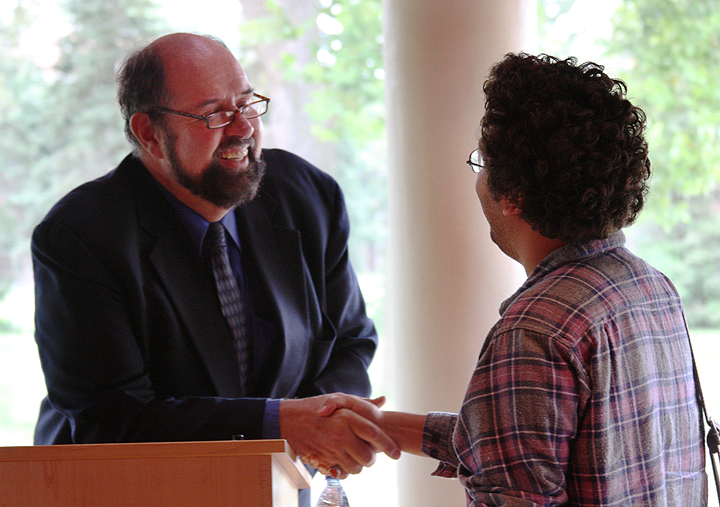
William Beeman shaking hands - Radka Slamova
Q: What is public perception of Iran in America? Why do you disagree with it?
A: I think people see Iran as, it’s been characterized by a lot of people as a medieval backward country that’s ruled by repressive religious forces, and the picture also paints Iran as this very dark, gloomy place. And this is, you know, I didn’t say this explicitly in the talk, but the first thing you want to dispel is this notion. Because most Iranians live with economic and political difficulty, but for the most part the Iranians live a very happy life.
The idea, too, that the place is ruled by mullahs is wrong. During the time when Ayatollah Khomeini was established as the spiritual leader, yes indeed, they put a lot of clerics in positions of authority. But over the years they’ve proven to be not very good managers. … They’ve gradually been replaced by people who really knew what they were doing. So even in government, maybe 25 percent are still bona fide clerics, but the balance of the government is all now secular individuals, or people who stopped pretending that they’re clerics.
And getting to be a high-ranked cleric is also, I should say, not necessarily a guarantee that you’re going to be conservative. And what you find is that you go to the theological schools in the city of Qom. It’s a big capital with theological training, and some of those clerics, first of all they are just so smart, they have the equivalent of a Ph.D. in philosophy, and of course they know Arabic and they are skilled in argumentation. And many of them are very, very liberal, and very radical, and they also feel that they have the right to come out and just flatly criticize the government, which they do on a regular basis. So being a mullah, so to speak, is not a guarantee that you’re going to be conservative.
So both of those stereotypes that mullahs run the government is not correct, and the stereotype that mullahs are very conservative is not correct.
Q: What is the root of strained relations between Iran and America?
A: Well there are two sides to it. There are Iran’s problems with the United States. And these go way back. In Iranian thinking, the United States is an extension of Great Britain, and in the 19th century, Great Britain and Russia more or less divided up the country into spheres of influence, and the British had enormous influence over Iranian politics and the Iranian government. … In 1952, the Prime Minister then, Muhammad Musaddiq nationalized the Iranian oil company. The British were furious about the nationalization of oil, and the United States was afraid that Musaddiq was creating an unstable situation, so the U.S. staged a coup and brought the Shah back into power and deposed of Musaddiq. This was the first time the United States had acted really directly to deal with Iranian internal affairs. Then gradually over time the United States developed commercial relations with the Shah…The U.S. sold arms to Iran, lots of them, extensively for the defense of the country, but the Shah more or less used the increased military expenditure to develop a very strong defense force that also repressed the population of the country. So gradually there was opposition to the Shah because of his repressive tendencies, [and this was] also directed towards the United States for their support of the Shah…Then when the revolution finally came in ’78-’79, the United States made the terrible mistake of admitting the Shah to the United States for medical treatment. This was a big surprise to the Iranians, they didn’t know he was sick. And when they’d heard he had cancer and he was going to the U.S., they thought “uh oh, here we go again. They deposed the government in 1952 and restored the Shah, and now they’re bringing the Shah to the United States to make plans to depose the government again.” So they wanted to send their own doctors to New York to examine him to see if he really had cancer because they didn’t believe it. And then the U.S. refused. And that was the thing that touched off the takeover of the American embassy. The American embassy was taken over then, and many people in Washington view this as the most awful insult that has ever been leveled against the Unites States.
So the United States started to have trouble, serious trouble, at the time of the hostage crisis. The U.S. broke off diplomatic relations at that time with Iran and they’ve never restored them. Gradually, the U.S. imposed economic sanctions upon Iran, it’s not clear why …but these sanctions were renewed under Bill Clinton, and then finally under George W. Bush we had a whole neoconservative agenda that had been cooked up during the 1990s to affect regime change in all of the countries in the Middle East and get rid of the Iranian government.
And the U.S. tries to find ways to make up an excuse for attacking Iran that would be plausible to the American public. So once again they renewed the idea that Iran was supporting terrorists worldwide. And then they claimed that Iran was attacking the U.S. through proxies in Iraq. And finally they hit on this nuclear idea, as a justification for attacking Iran. So you can see that there’s a lot of bad blood between the two nations. And untangling 30 years of hostility is really, really tough. And a lot of it is actually quite emotional, not even substantive.
In point of fact, Iran hasn’t done anything to the United States, not anything, they haven’t done anything. I mean they kicked out the Shah, but it was their Shah. The charge that they were attacking the U.S. military in Iraq turned out to be completely unsubstantiated. They haven’t attacked Israel—they haven’t done anything to us. And yet the United States is still claiming that they are the most dangerous people in the world, the most dangerous nation on Earth. And Iran can point to several things that the United States has done to Iran.
Also what’s happened in the last ten years is that US-Iranian relations, they weren’t very good, but they were separate from U.S.-Israeli relations. The last decade, they’ve become united. And there’s a kind of formula—if you’re soft on Iran or friendly towards Iran, then you’re an enemy to Israel. It’s kind of amazing because we really should be pursuing separate tracks in my way of thinking. This affects American political life, because nobody, no politician can come out and say not even anything positive, or they can’t even say we should rethink our dealings with Iran—because then they get attacked by people who say they’re not supporting Israel, because in order to be a friend of Israel they have to be an implacable enemy of Iran.
Anyway, I know that sounds long, but it’s kind of a short litany of these grievances between the two.

Saturday, September 18, 2010

Reality check: Iran is not a nuclear threat--Christian Science Monitor

http://www.csmonitor.com/Commentary/Opinion/2010/0917/Reality-check-Iran-is-not-a-nuclear-threat

The Christian Science Monitor - CSMonitor.com

Reality check: Iran is not a nuclear threat

Forget the neoconservative hype. The facts show Iran is not and has not been a nuclear threat to either the United States or Israel.
By Scott Horton
posted September 17, 2010 at 12:42 pm EDT
Comment by William O. Beeman:  Many of us have been trying to get this message across to the American public since 2003. The claim that Iran was making nuclear weapons was an excuse promulgated by the neoconservatives of the Bush administration to make attacking Iran acceptable to the U.S. body politic. Sadly, though there is ABSOLUTELY NO PROOF that an Iranian nuclear weapons program exists, it has now been presented so often that most Americans believe it to be true. This is a sad commentary both on our political life and on the American media. Please read and forward this piece widely.

Los Angeles —
Politicians, lobbyists, and propagandists have spent nearly two decades pushing the lie that Iran poses a nuclear weapons threat to the United States and Israel. After a brief respite in the intensity of the wolf cries over the past two years, the neoconservative movement has decided to relaunch the “Must Bomb Iran” brand.
The fact that Iran is not and has not been a nuclear threat to either nation is rendered irrelevant by a narrative of universal “concern” about its nuclear program.

US media distortions

In mid-August, for example, after The New York Times quite uncharacteristically ran a piece diminishing the supposed danger of Iranian nukes, the story was misrepresented in newspapers and on TV stations across the country in the most frightening terms. As MSNBC’s news reader put it that afternoon: “Intelligence sources say Iran is only one year away from a nuclear bomb!”
On August 13, on Fox News, former US ambassador to the UN John Bolton implicitly urged Israel to attack Iran’s new light-water reactor at Bushehr before it began “functioning,” the implication being that the reactor represented some sort of dire threat. But the facts are not on Mr. Bolton’s side. The Bushehr reactor is not useful for producing weapons-grade plutonium, and the Russians have a deal to keep all the waste themselves.
On September 6, the International Atomic Energy Agency (IAEA) released a new paper on the implementation of Iran’s Safeguards Agreement which reported that the agency has “continued to verify the non-diversion of declared nuclear material in Iran to any military or other special purpose.”
Yet despite the IAEA report and clear assertions to the contrary, news articles that followed were dishonest to the extreme, interpreting this clean bill of health as just another wisp of smoke indicating nuclear fire in a horrifying near-future.
A Washington Post article published the very same day led the way with the aggressive and misleading headline “UN Report: Iran stockpiling nuclear materials,” “shorthanding” the facts right out of the narrative. The facts are that Iran’s terrifying nuclear “stockpile” is a small amount of uranium enriched to industrial grade levels for use in its domestic energy and medical isotope programs, all of it “safeguarded” by the IAEA.

More sensational claims

If the smokescreen wasn’t thick enough, late last week a group of Marxist holy warrior exiles called the Mujahadeen-e-Khalq, working with the very same neoconservatives who sponsored Ahmad Chalabi’s Iraqi National Congress – which manufactured so much of the propaganda that convinced the American people to support the invasion of that country – accused the Iranian government of building a secret nuclear enrichment facility buried deep in tunnels near Qazvin.
Headlines once again blared in total negligence and without verification that here indeed was, an official told Fox News, proof that Iran has a “hidden, secret nuclear weapons program.’” TV news anchors on every channel furiously mopped sweat from their brows, hearts-a-tremor. When will the forces of good rise to stop this evil?!
Yet even US officials quickly admitted that they’ve known about these tunnels for years. “[T]here’s no reason at this point to think it’s nuclear,” one US official said – a quote that appeared in Fox’s article, but only after five paragraphs of breathless allegations. All day long, top-of-the-hour news updates on TV and radio let the false impression stand.
IAEA inspectors have had open access to the gas conversion facility at Isfahan, the enrichment facility at Natanz, and the new lightwater reactor at Bushehr, as well as the secondary enrichment facility under construction at Qom.

An ignored clean bill of health

The September 6 IAEA report confirming for the zillionth time the non-diversion of nuclear material should be the last word on the subject until the next time they say the same thing: Iran, a long-time signatory of the Nuclear Non-Proliferation Treaty (NPT), is not in violation of its Safeguards Agreement.
So what’s all the hubbub about Iran’s “nuclear defiance” and “danger”?
The IAEA’s latest report does note that Iran has “not provided the necessary cooperation to permit the Agency to confirm that all nuclear material in Iran is in peaceful activities.” Indeed, the agency’s frequent mentions of Iran’s “lack of full cooperation” is a big reason why US media reports portray Iran in ominous terms.
But here, too, US media frequently miss the point. Never mind that 118 nations around the world have signed a statement criticizing the IAEA’s “peaceful activities” conclusion as a departure from standard verification language. More broadly, Iran’s “lack of full cooperation” by itself is an outcome of Western bullying and propaganda.

Real reason for lack of cooperation

The US and the UN, acting upon no legitimate authority whatsoever, have demanded that Iran submit to an Additional Protocol to the Safeguards Agreement, which would ban any further enrichment on Iranian soil, as well as demanded they submit to an endless regime of IAEA inspections and questioning, based mostly on the “alleged studies” documents, which several sources have said are forgeries posing as a pilfered laptop of a dead Iranian nuclear scientist.
These separate, UN Security Council-mandated investigations have even demanded blueprints for Shahab 3 missiles – a subject far removed from hexafluoride gas or any legitimate IAEA function. In 2003, Iran voluntarily agreed to the extra burden of the unratified Additional Protocol during “good faith negotiations” with the so-called “E-3,” Britain, France, and Germany, acting on behalf of the US. When those negotiations broke down, Iran withdrew in 2006.
With these details left out of the discussion, the impression is left that Iran is refusing to abide by international law, when in fact, it is completely within its NPT obligations.

An outrageous standard

Meanwhile, Washington continues to apply to Iran the outrageous standard it used in the run-up to the Iraq war: an unfriendly nation must “prove” it doesn’t have dangerous weapons or a secret program to make them – or potentially face military action.
“Proving a negative” is, to say the least, a difficult obligation to meet: You say you haven’t read Webster’s Dictionary cover to cover? Prove it!
The bottom line is that Iran is still within its unalienable rights to peaceful nuclear technology under the NPT and the Safeguards Agreement – a point even Tehran’s fiercest critics (grudgingly) acknowledge. The only issues it is defying are the illegitimate sanctions and demands of the US and UN, which themselves defy logic and sense.

Journalists’ ethical obligation

It is far past time for the members of the American media to get their act together and begin asking serious follow-up questions of the politicians, “experts,” and lobbyists they interview on the subject of Iran’s nuclear program.
Many of these same journalists still have the blood of hundreds of thousands of innocent Iraqis on their hands from the months they spent continuously and uncritically parroting the lies, half-truths, and distortions of agenda-driven Iraqi dissidents and their neocon champions who pushed us into the Iraq war.
Perhaps this is their shot at redemption.
Scott Horton is host of Antiwar Radio on the Liberty Radio Network and assistant editor at Antiwar.com.

Thursday, June 24, 2010

William O. Beeman--Regime Change in Iran: The Fantasy That Will Not Die (New America Media)

http://newamericamedia.org/2010/06/regime-change-in-iran-the-fantasy-that-will-not-die.php


Regime Change in Iran: The Fantasy That Will Not Die

William O. Beeman
New America Media

June 18, 2010

The American political establishment will not give up the fantasy that they can somehow bring about regime change in Iran—that the United States can somehow topple the Iranian leadership just like it supposedly toppled the Soviet Union.

Senators John Cornyn of Texas and Sam Brownback of Kansas have introduced legislation (S-3008) that, in Cornyn’s own words: “. . . states that it is U.S. policy to support the Iranian people’s efforts to establish a truly democratic and accountable government and free themselves from the regime headed by Ahmadinejad and Supreme Leader Ali Khamenei. ”

Self-avowed neoconservative Reuel Marc Gerecht, a senior fellow at the Foundation for Defense of Democracies, wrote an op-ed in the New York Times on June 14 entitled "Iran's Revolution: Year 2.” It calls on the Obama administration to support the Green Movement to effect regime change. He writes: “By throwing in his lot with the freedom movement, (President Obama) would surely increase the odds that we won’t have to live with a nuclear bomb controlled by virulently anti-American and anti-Semitic clerics. Democrats, once the champions of promoting pro-democracy movements, need to understand that the good that they can do for the people of Iran far exceeds the great harm that comes from doing nothing.”

Not to be outdone, Democrats are doing something, too. Congressman Gary Ackerman (D-N.Y.) introduced a resolution in 2008 with Congressman Mike Pence (R-Ind.) declaring that Iran was inimical to "the vital national security interests of the United States" and "demanding" that the president impose a full-scale naval, air and land blockade on Iran effectively, an act of war. The resolution failed, but Ackerman continues to press for similar actions from the Obama administration.

The question of regime change in Iran is warmed-over Cold War logic dating from the Revolution of 1978-79. In 1980, Edward Sa'id wrote a trenchant piece in the Columbia Journalism Review. He made the point that the dominant government stance after the Revolution had nothing to do with understanding Iran or Iranian history. Instead it asked just one question: "Is Islam for or against the United States?" And, of course, he meant Iran as the embodiment of Islam at that moment.

The answer that has emerged over four decades in the regime change circles is clearly that "Islam (read Iran) is against the United States." It is from that point that the fantasizing begins: How to destroy this anti-American regime.

The government of Israel has succeeded in creating a codicil--also right out of the Cold War: "What threatens Israel also threatens the United States."

The answers are Cold War answers. No imagination. No attempt to understand Iran in social, cultural or historical terms. Just a repeat of what "worked" to bring down the Soviet Union short of direct attack: isolation, inflicting economic pain, scaring the world into thinking “the enemy” is dangerous, and finally fomenting and encouraging internal dissent.

The reason this rhetoric works is because the U.S. public and perhaps many Europeans are already primed to accept both this logic and these solutions having been taught to fear the Soviet Union for three decades. However these stratagems won't work with Iran. Iran is not the Soviet Union. Iran sees itself not as the aggressor, but rather the defender.

All of these strategies have thus far failed.

Isolation of Iran is not working. At a recent conference on the Middle East in London, a leading Italian economist said: "We are Iran's largest European trade partner. When our businessmen show up in Tehran, there are three Chinese businessmen waiting in the outer office. The U.S. is driving Iran into the hands of Asian partners, and ruining our business with them--and for what? To satisfy some American ideology?" The only nation that truly desires Iranian isolation and believes that it can be achieved is the United States.

Inflicting economic pain is not only ineffective, it is counter-productive. We may have brought the Soviet Union down by creating an arms race that they couldn't sustain, but nothing we have or could do to Iran is going to cripple the country to the point of collapse, and it is laughable to think that that could happen. The Iranian people are inconvenienced by these low-level unilateral economic sanctions, such as those pushed through the United Nations Security Council on June 9, 2010, and the U.S. Treasury on June 16. They thus are embittered about the United States, but nothing more. It most decidedly does not make U.S. overtures to them to overthrow their own government more probable.

Scaring the world about Iran has been a complete failure outside of the United States. No one has any proof whatever that Iran has a nuclear weapons program--it is a red herring, and the world knows it. The Non-aligned Movement has continually issued support for Iran’s nuclear energy program. Even if there were a nuclear military program, Iran is years away from having anything that could pass for an effective weapon. The Gulf States may be concerned, as they always have been, about the Shi'a community, since they constitute either a majority (Bahrain) or a significant minority (UAE, Saudi Arabia), but the dead-end idea promulgated by the Bush administration and carrying forward, that Iran is about to attack its neighbors--and with a non-existent nuclear warhead--is the stuff of fiction. Iran would destroy its own economy if it did this. Its relations with its neighbors are completely symbiotic.

Finally, Cornyn and Brownback, Ackerman, Gerecht, and others of their ilk utterly misunderstand the post-1999-election Green Movement in Iran. If the movement is eventually successful, it will not usher in some kind of purging revolution that will create a pro-American government. The Green Movement is about legitimacy of leadership within the current Iranian governmental framework, not about overthrowing the government. Nor will trying to foment dissent in Iran's many ethnic communities, another strategy favored by the regime-change fans, be any more effective. The many ethnic groups that make up Iran’s pluralistic civilization have identified with Great Iranian civilization for more than two millennia.

The worst part of the push for regime change is that the more the United States and other external powers interfere in Iranian affairs, the less likely it is that change will occur. Has no one in power read Iranian history? Does no one understand how Iran has constructed the United States in its own paranoid fantasies? U.S. interference taints every attempt at reform from within, make no mistake.

If there is to be regime change in Iran, it will be from within, over time (and not such a long time frame, either). Yes, talk about the real problem of human rights. Yes, engage in dialogue, but give up the Cold War strategizing with bankrupt, inappropriate methods. They won't work. And open chatter about more strategies for "regime change" merely feeds the Iranian power elite the stuff they need to blame their every weakness and failing on the United States.

William O. Beeman is professor and chair of the Department of Anthropology, University of Minnesota. He has lived and conducted research in Iran and the Middle East for more than 30 years and is the author of The “Great Satan” vs. the “Mad Mullahs”: How the United States and Iran Demonize Each Other (Chicago, 2008).

Sunday, January 03, 2010

Strategic Leaking on Iran (from Gary Sick's public blog)

From Gary Sick's public blog

Note from William O. Beeman:
Gary Sick's superb analysis of recent information leaked from the White House to the Washington Post
and the New York Times has the ring of truth. The New York Times article appeared on Sunday, January 3, but carried
a dateline of January 2. It can be found at http://www.nytimes.com/2010/01/03/world/middleeast/03iran.html?hp 
 
Pretend for a moment that you are the president of the United States and 
you have gotten yourself into a bit of a hole with your Iran policy.

First you offered to negotiate with Iran over nuclear (and potentially 
other) issues without the Bush preconditions. But there were powerful 
political forces that felt this was an example of your inexperience and 
even appeasement tendencies. So you unwisely accepted a six month deadline 
for the negotiations to show that you meant business. You tried to soften 
that by saying you would take another look at the issue at the end of the 
year, but everyone ignored that and let you know that January 1 was the 
drop dead date to solve all the negotiating problems with Iran.

In the meantime, the most serious internal revolt in thirty years exploded 
in Iran. It was not clear how this would affect the behavior of the regime 
on international issues. Some said the regime was weakened and vulnerable 
and so would more readily yield to pressure; others thought Iran's rulers 
would become more belligerent internationally to compensate for their 
internal weakness.

You had a couple of rounds of meetings with the Iranians and jointly came 
up with a fiendishly clever ploy. Iran would ship out quite a lot of its 
low enriched uranium (LEU), thereby reducing its stockpile that might be 
turned into a bomb, and Russia and France would provide them with more 
highly enriched fuel to be used in their research reactor that makes 
medical isotopes. Everybody wins. But when the Iranians took this home, 
they were savaged by their own political opposition for buying a pig in a 
poke. In disarray, they backtracked and started looking for a face-saving 
alternative, specifically to conduct the swap on Iranian soil or, later, 
in Turkey.

This situation was complicated by the discovery (or Iranian announcement, 
we're not quite sure) of a previously unannounced uranium enrichment site 
which was immediately inspected by the IAEA. Some think that this was 
Iran's Plan B, to have a separate enrichment capability if the primary 
site at Natanz was bombed by Israel or the US; others think the site was 
intended as a covert production line to produce a bomb. The punditocracy 
decides that it was a covert bomb production line.

Moreover, the punditocracy, which had already decided on the deadline of 
January 1, now decides that the Iranians negotiated in bad faith and the 
negotiations were at a total dead end. The congress, which had reluctantly 
stayed quiet on the subject, now returned to its usual political game of 
looking tough by bashing Iran. Sanctions bills threatening interdiction of 
gasoline shipments to Iran were passed overwhelmingly in the House and 
were due to pass with equal margins when the Senate returned in January.

Your critics (who wanted merely token negotiations followed by crippling 
sanctions and, if possible, war) rubbed their hands in anticipation. A 
leading neoconservative gleefully remarked that everything was proceeding 
according to script. AIPAC issued a triumphant declaration as gasoline 
sanctions rolled through the congress -- Thread 15 or at: 
http://www.aipac.org/NearEastReport/20091230/house-passes-iran-sanctions-bill.html

So, Mr. President, here you are on January 1. The "deadline" is upon you. 
Your allies and your opponents in congress are ready to hit you with a 
dilemma -- either impose crippling sanctions or look like an appeaser. Yet 
you know that gasoline sanctions are perhaps the worst idea to come out of 
the Congress since they opposed the purchase of Alaska. The sanctions 
would enrich and empower the Revolutionary Guards, undercut the Green 
opposition, identify the US as the enemy of the ordinary citizen in Iran, 
and possibly start us down the slippery slope to another disastrous war in 
the Middle East. But it looks great on a bumper sticker, and Glen Beck 
will savage anyone who dares oppose it.

So what to do?

Well, Mr. President, you have some cards of your own up your sleeve. You 
know that Israel is not really going to attack Iran. They can't do 
anything significant without US help, and George Bush already told them 
not to expect that. But they have invested so much in their campaign to 
convince the Israeli population and the entire world that Israel's 
survival as a nation is imminently in peril that they can't be seen to 
back down. They might welcome some help to get them off their own sticky 
wicket.

You also know that the Iranian nuclear program is nowhere near a bomb and 
has actually made little progress in that direction for years, regardless 
of the punditocracy consensus to the contrary in defiance of the facts. 
There is plenty of time if you can just calm the domestic political furor.

It's time for some strategic leaking.

First, give an exclusive interview to the Washington Post just before the 
New Year's "deadline" -- Thread 15 or 
http://www.washingtonpost.com/wp-dyn/content/article/2009/12/29/AR2009122903415_pf.html 
that makes two major points: (1) The administration's policy of engagement 
has succeeded in creating turmoil and fractures within Iran's leadership, 
i.e. the policy has been a success, not a failure; and (2) the 
administration is planning for highly targeted sanctions that will hit the 
Revolutionary Guards rather than the average Iranian citizen. That sends a 
clear signal to the congress that its infatuation with petroleum sanctions 
is not replicated in the White House, for all the reasons listed above, 
and to the uber hawks that there will be no rush to war with Iran in the 
new year. At the same time, launch a major rhetorical campaign by the 
president in support of the civil and political rights of the Iranian 
opposition.

It works. The increasingly hawkish Washington Post editorial board 
commends the president for his "shift" on human rights (though piously 
calling for more) and ignores the sanctions game in congress. 
http://www.washingtonpost.com/wp-dyn/content/article/2009/12/28/AR2009122802007.html

Of course, having fed the Washington Post, the New York Times is jealous 
and needs its own exclusive. Provide that over the New Year holiday by 
letting as many as six top administration officials meet privately and 
anonymously with two NYT reporters to let them in on some more secrets: 
(1) In another cunning success, the administration has outed the covert 
Iran bomb production facility at Qom thereby rendering it useless; (2) 
hint that the administration may be responsible for sabotaging Iran's 
centrifuges, which accounts for the fact (completely unacknowledged until 
now, despite being reported for the past two years by the IAEA) that Iran 
is not actually using about half of its installed centrifuges; (3) 
reiterate that the coming sanctions are to be aimed at the Revolutionary 
Guards, not the average Iranian citizen, and are likely to succeed because 
the regime is so weakened internally; and (4) declare unequivocally that 
the Iranian "breakout capability," i.e. its ability to shift from nuclear 
energy to actually building a bomb, is now years away.

This also works. The two NYT reporters, though apparently a bit confused 
about this U-turn in threat assessment from only three months ago, 
dutifully report what they have been told. The administration is credited 
with several successes, and the reporters seem convinced that the White 
House is showing toughness and skill in derailing the Iranian nuclear rush 
to the bomb. In the meantime, the reporters scarcely note that the 
administration is not declaring the negotiations dead after all and is 
pursuing the Turkish option of a uranium swap. No mention of a deadline.

Finally, the NYT reports that the Israelis have been persuaded that the 
targeted sanctions now being discussed are worth trying "at least for a 
few months." That was attributed to a senior Israeli official on the basis 
of back channel talks, but it had actually been announced by Prime 
Minister Netanyahu to the Knesset a week earlier in a speech that received 
almost no attention in the U.S. See Thread 26 or 
http://www.pmo.gov.il/PMOEng/Communication/PMSpeaks/speech40sigh231209.htm 
No more talk of deadlines, crippling sanctions or air strikes.

In short, Mr. President, you have taken what appeared to be a losing hand 
and, with a few well-placed leaks, transformed it into a victory over 
Iran. You have converted a lose-lose proposition of crippling sanctions vs 
appeasement into an Iranian nuclear collapse. The imminent threat of Iran 
has become an indefinite delay of its breakout capability. The huffing and 
puffing of the congress has been rendered irrelevant even before it hits 
your desk. A deadline has become a new beginning of negotiations. And you 
brought the Israelis along with you, without a peep of complaint. As for 
the punditocracy, so far so good.

Not bad for a beginner, Mr. President!


Sunday, December 27, 2009

Bomb, Bomb Iran: Lessons From Iraq Unlearned

Note: Alan J. Kuperman of the University of Texas wrote a 1500 word op-ed for the New York Times on December 24 calling for the United States to bomb Iran. This astonishing essay has been widely attacked, but the following long essay by Jeremy Hammond is the best response that I have seen so far. I myself have made all of the points included in this essay in the past, but the skillful presentation here makes it extremely important reading.

William O. Beeman

____________________

FOREIGN POLICY JOURNAL

Sunday, December 27, 2009

Bomb, Bomb Iran: Lessons From Iraq Unlearned
December 26, 2009
by Jeremy R. Hammond

In a New York Times op-ed this week that advocates bombing Iran, the author, Alan J. Kuperman, director of the Nuclear Proliferation Prevention Program at the University of Texas at Austin, begins by suggesting that President Barack Obama should “sigh in relief that Iran has rejected his nuclear deal”.

In fact, Iran has said it is still open to discussion with the U.S. about its nuclear program, but that if meaningful dialogue is to continue, the threats of sanctions and military aggression must first cease.

The U.S., however, continues to threaten yet further sanctions, while also insisting that the threat of force must remain “on the table” — a threat of aggression that itself violates the U.N. Charter, which forbids member nations from threatening the use of force as a tool for leverage in international relations.

Kuperman’s reason for why Obama should be happy is that the deal, under which Iran would export uranium to Russia, which would enrich it to 20 percent (not the 90 percent required for weapons-grade uranium) and return it as fuel rods for use in Tehran’s research reactor, “was ill conceived from the start” since Iran would “thus be rewarded with much-coveted reactor fuel despite violating international law.”

His reference is to U.N. Security Council resolutions demanding that Iran halt its uranium enrichment activities. The problem with these resolutions, as Iran is not hesitant to point out, is that they themselves directly violate the nuclear non-proliferation treaty (NPT), which clearly states that parties to the treaty have an “inalienable” right to enrich uranium for peaceful purposes, and that the international community may take no action prejudicial towards that right.

The U.N. resolutions, needless to say, prejudice that “inalienable” right, particularly given the fact that there is no credible evidence that Iran has a nuclear weapons program – as both the U.S. intelligence community and the International Atomic Energy Agency (IAEA) have pointed out.

In other words, under U.S. influence, the Security Council in this case has acted as a rogue body itself in violation of relevant treaties constituting international law and the very Charter under which it ostensibly operates.

Iran, on the other hand, remains in compliance with the terms of the NPT and is meeting its obligations in allowing the IAEA to monitor and inspect its nuclear program, despite much talk to the contrary.

Take the most recent example, the charge that Iran’s uranium enrichment facility near Qom, still under construction, was a violation of its obligation to declare any such facility prior to the beginning of construction. We’re told that Iran agreed to an updated version of its safeguards agreement with the IAEA containing a clause specifying that obligation.

What we’re not told is that at that time, Iran had agreed to implement the terms of the Additional Protocol and revised safeguards agreement on a strictly voluntary basis. The voluntary nature of Iran’s implementation of these measures was explicitly, and in writing (see the so-called Paris Agreement), recognized by the IAEA. Iran was under no legal obligation to do so and had done so simply as a “confidence-building measure”.

In return, Iran got nothing but further threats of sanctions and bombing. So it ended its voluntary observance of measures above and beyond that which was legally required of it.

The fact is that Iran has never ratified the revised safeguards agreement, as would be required for the revisions to be legally binding upon Iran. Under the safeguards agreement Iran has formally and legally obligated itself to, it need only declare such facilities six months prior to the introduction of nuclear material (i.e., introduction of uranium into enrichment centrifuges), which is exactly what Iran did in declaring the site several months ago.

In response to meeting its obligations under its safeguards agreement, the West responded by declaring that the “secret” site (an adjective irreconcilable with the fact Iran voluntarily declared it to the IAEA, but obligatorily used in the media anyways) was evidence of Iran’s intentions to manufacture nuclear weapons.

Summarily dismissed was Iran’s quite credible explanation for the site it voluntarily disclosed, which was that it was attempting to diversify its uranium enrichment capabilities under the threat of certain countries to bomb their nuclear facilities.

The demonization and punishment of Iran for its compliance with its obligations under international law is not entirely unlike the charges against Iraq that it was in violation of U.N. Security Council resolutions demanding it disarm because it had not disarmed, when in fact it had disarmed, and when in fact there was no credible evidence that it still possessed stockpiles or was still in production of weapons of mass destruction (WMD).

The IAEA, for its part, has continuously and consistently reported that it has verified Iran has diverted no nuclear materials towards a weapons program. Former Director General of the IAEA Mohammed ElBaradei, whose term ended just last month, has repeatedly said that there is no evidence Iran has a nuclear weapons program. His successor, Yukiya Amano, has made the same observation.

Then, of course, there is the 2007 National Intelligence Estimate (NIE) from the U.S. intelligence community that stated Iran today has no nuclear weapons program, which according to Newsweek, is an assessment analysts still stand by. The NIE did claim that Iran once had such a program in the past, but that it ended it in 2003. The IAEA, on the other hand, recently issued a statement saying there is no evidence Iran ever had a weapons program.

Kuperman continues by suggesting that the goal of the international community should be to “compel” Iran “to halt its enrichment program”, which, he claims, the proposal to send its uranium abroad would not have done. It’s worth noting the fact that this is an explicit rejection of the NPT.

He adds, “In addition, the vast surplus of higher-enriched fuel Iran was to get under the deal would have permitted some to be diverted to its bomb program”, claiming that taking uranium from the fuel rods for further enrichment to weapons-grade “is a straightforward engineering task requiring at most a few weeks.”

The truth of the latter assertion aside, which is contrary to most reports on the subject and contrary to the whole supposed point of the deal, what’s notable here is the assumption that Iran has a “bomb program”, despite, as was the case with Iraq, the total lack of credible evidence to support the claim.

It’s enough in the mainstream corporate media simply to take Iran’s “bomb program” as a matter of faith. Evidence is simply not required, and it’s considered perfectly acceptable by the editors of the New York Times and other mainstream sources to print assumptions expressed as statements of fact.

Again, for those who don’t suffer from selective amnesia and aren’t prone to intentional ignorance, the kind of reporting we saw from the Times, et al, prior to the invasion of Iraq might perhaps serve as a lesson about the nature of the role U.S. corporate media play in “manufacturing consent” from the American public for U.S. foreign policies.

Kuperman next begs the question, “if the deal would have aided Iran’s bomb program, why did the United States propose it, and Iran reject it?” Oblivious to the fallacies underlying the question, his own answer is that “The main explanation on both sides is domestic politics.”

Obama simply wanted to “blunt Republican criticism that his multilateral approach was failing” and was seeking a short-term gain.

Iran, for its part, “rejected” the deal that, by Kuperman’s own account, would have helped it towards the presumed goal of achieving the bomb because “such a headlong sprint” towards that goal “is the one step most likely to provoke an international military response that could cripple the bomb program before it reaches fruition.”

In other words, while Israel regularly threatens that it won’t wait much longer for the U.S. to come to some agreement with Iran before it launches an attack against Iran’s nuclear sites that Iran’s possession of the bomb would surely deter, Iran is willing pass up an offer that would constitute “a headlong sprint” towards such a deterrent because doing so could actually jeopardize the possibility of it obtaining the bomb, since if Iran accepted the deal ostensibly designed to prevent it from being able to enrich uranium to weapons-grade, Israel would be even more likely to bomb their nuclear sites even sooner than if it Iran just rejects the proposal.

Truly, Kuperman has a dizzying intellect.

“In sum,” writes Kuperman, “the proposal would not have averted proliferation in the short run, because that risk always was low, but instead would have fostered it in the long run – a classic example of domestic politics undermining national security.”

In sum, Iran is damned if it does and damned if it doesn’t.

Thus, the bombing of Iran is a foreseeable and unavoidable consequence of the present U.S. policy towards Iran. This consequence, admittedly, might very well be disastrous, but the obvious solution – to alter U.S. policy – is simply inconceivable. A change of policy is off the table. The resort to violence is not.

It’s worth noting that Kuperman acknowledges that the “risk” of Iran obtaining the bomb anytime soon (assuming it actually is seeking it) “always was low”. This is an interesting admission given the tendency of Western media to portray Iran as being practically right on the verge of being able to manufacture a nuclear weapon.

Returning to Iran’s “rejection of the deal”, Kuperman suggests the so-called “rejection” was “likewise propelled by domestic politics – including last June’s fraudulent elections and longstanding fears of Western manipulation.”

The “fears of Western manipulation” is a valid enough observation, the fears warranted enough. But again, as with the presumption of an Iranian bomb program, it’s enough in U.S. mainstream media to assert the claim of “fraudulent elections” as fact, despite the spurious nature of the evidence for fraud and many strong indications that Mahmoud Ahmadinejad legitimately won, including polls conducted by Western organizations both prior to the vote and since showing strong support for his presidency.

Like the “rejection” of the deal, Kuperman goes on to repeat what has become another unquestioned part of the official narrative. Suggesting that President Ahmadinejad “initially embraced the deal because he realized it aided Iran’s bomb program”, he adds, “But his domestic political opponents, whom he has tried to label as foreign agents, turned the tables by accusing him of surrendering Iran’s patrimony to the West.”

The possibility that Iran has not accepted the deal because it consists of an implicit rejection of their right to enrich uranium for themselves is, like the thought of changing U.S. policy, simply inconceivable.

The claim that Ahmadinejad “initially embraced the deal”, only to “renege”, has become standard. But the claim, though widely reported, cannot stand up to scrutiny based on the actual facts that have been reported about the talks. Every indication is that Ahmadinejad himself was open to the proposal, which he continues to be, on the condition that the West cease its threatening and aggressive posture towards Iran, and that the Iranian negotiators during the talks agreed with the proposal on principle, in anticipation of further talks, without formally accepting the deal – something, Iran has pointed out, the negotiators were given no authority to do.

This is part of a larger narrative in Western media in which the Iranian leadership is fractured and the regime in a state of crisis due to the enormity of the opposition to Ahmadinejad’s rule (part of the “fraudulent elections” narrative). While there are elements of truth to this story line, it’s chiefly a product of wishful thinking and the willingness of commentators to succumb to their own propaganda.

Take, for example, reporting on the massive gathering of people honoring the influential Grand Ayatollah Hussein-Ali Montazeri upon his death just last week. The opposition, we were told, of whom Montazeri was a leader, effectively took over the rally and was able to turn it into a massive anti-regime protest. Evidence for this was given in the form of amateur videos apparently from cell phones posted to opposition websites showing close-up shots of protesters shouting anti-regime slogans and holding up anti-regime banners.

Wider video shots of the actual funeral march, however, showed only an enormous crowd solemnly and respectfully marching along with the casket, holding up only photos of the cleric, not anti-regime banners. (The London Times, a leading outlet for anti-Iran propaganda, acknowledges that, with no journalists in the country due to restrictions on foreign media operations, much of its reporting comes from anti-regime elements, but insists that its sources are trustworthy, essentially a “just trust us” assertion that depends upon the questionable trustworthiness of the Times itself as a source for news on Iran.)

“Under such domestic pressure, Mr. Ahmadinejad reneged”, claims Kuperman, and then “threatened to enrich uranium domestically to the 20 percent level.” Notice how remarks from Iranian leaders that Iran would do what it has an “inalienable” right to do as a party to the NPT is characterized by the verb “threatened”.

The underlying and familiar assumption is that the rules are set by Washington, not by treaties comprising the body of international law. A dubious enough assumption, but unquestionable in the mainstream.

Iran’s “rejection” of the proposal shows that it “cannot make even temporary concessions on its bomb program”, and therefore, “Since peaceful carrots and sticks cannot work,” – (more the stick than the carrot) – “and an invasion would be foolhardy, the United States faces a stark choice: military air strikes against Iran’s nuclear facilities or acquiescence to Iran’s acquisition of nuclear weapons.”

There are numerous and obvious other options: to assume that evidence should be required of an Iranian nuclear program rather than establishing confrontational and aggressive policies based on the assumption that this is so; to cease from violating international law with threats of military aggression; to cease from deliberately isolating and provoking Iran and instead meaningfully engaging the country in a dialogue that actually recognizes Iran’s rights under the NPT; to live up to the additional obligation under the NPT for the U.S. and other nuclear-armed countries to provide member nations with nuclear technology for peaceful purposes, etc.

But it is simply inconceivable that mainstream sources like the Times would actually find “fit to print” such elementary alternatives.

Without reading further, the conclusion Kuperman would like his readers to draw (and here the headline, “There’s Only One Way to Stop Iran”, is relevant) is clear: obviously, we cannot acquiesce to Iran acquiring nuclear weapons; therefore the only logical choice is to bomb Iran.

To underscore the unacceptability of Iran obtaining the bomb, Kuperman employs a theme that should not be unfamiliar to Americans: “If Iran acquired a nuclear arsenal,” he writes, “the risks would simply be too great that it could become a neighborhood bully or provide terrorists with the ultimate weapon”.

He draws just short of saying that if we don’t bomb Iran, the consequences could come “in the form of a mushroom cloud”, the familiar official refrain prior to the invasion of Iraq – which had no nuclear program at all, much less a weaponized one (Kuperman states further in the article that this fact “eluded American intelligence until after the 2003 invasion”. U.S. intelligence analysts, we are apparently supposed to believe, never bothered themselves to read IAEA reports noting that the agency had completely dismantled Iraq’s nuclear program by the mid-90s).

And so we must bomb Iran. Now, “admittedly, aerial bombing might not work.” It could “backfire” by “undermining Iran’s political opposition, accelerating the bomb program or provoking retaliation against American forces and allies in the region.”

All three are credible consequences widely predicted among analysts. Iran may not have a nuclear weapons program now, but if it is bombed, the likelihood that it would withdraw from the NPT, move its nuclear weapons program underground, and begin work towards obtaining a nuclear deterrent to further such attacks would be increased in no inconsiderable measure.

Again, Iraq provides a useful lesson. It was a direct consequence of Israel’s bombing of Iraq’s Osirak reactor in 1981, according to the U.S.’s own intelligence assessments, that prompted Saddam Hussein to begin pursuing his nuclear program clandestinely and also to begin his pursuit to obtain nuclear weapons.

Kuperman actually mentions the Israeli attack on Iraq’s Osirak reactor to support his assertion that bombing Iran – the very thing he advocates – might actually result in Iran “accelerating” efforts to acquire a nuclear weapon, but he obscures the obvious lesson to be had from it by suggesting an opposite and much more dubious conclusion: that the bombing slowed down, rather than accelerated, Saddam’s efforts to obtain the bomb.

In other words, bombing Iran might predictably and admittedly result in the very thing the bombing would ostensibly be aimed at preventing. The obvious corollary is that the bombing would not really be carried out in order to prevent that end.

Again, further lessons from Iraq are instructive. Consider that the war ostensibly fought to make the world safer from WMD and to fight terrorism resulted in the single most probable situation, had Iraq actually had WMD, under which Saddam Hussein would have provided them to terrorists. Again, that was the assessment of the U.S. intelligence community prior to the invasion.

Fortunately, Iraq didn’t have WMD and so this never occurred. But among the direct consequences of the war that did occur was a considerable increase in the threat of terrorism, again according to the U.S.’s own intelligence assessments. Whereas prior to the invasion, terrorist attacks within Iraq were virtually unknown, since the war began, the Iraq people continue to be plagued by terrorism as a direct consequence of the war.

The war, analysts have observed, served as a virtual billboard for terrorist organizations to recruit individuals willing to commit acts of violence in response to U.S. foreign policy – just as U.S. support for Israeli crimes against the Palestinians was a principle causal factor for the 9/11 attacks, if we are to believe the stated grievances of the originally accused mastermind of those attacks himself.

Again, the corollary is obvious: the official reasons for committing such acts of aggression against foreign nations, if we presume leading policymakers are sane and rational, cannot possibly be the actual rationale for them. That is perfectly elementary, albeit a virtual heresy to actually point out in respectable circles.

The war against Iraq had nothing to do with WMD or terrorism. Equally elementary is the observation that U.S. policy towards Iran has nothing to do with preventing it from obtaining nuclear weapons.

A further example is NATO’s bombing campaign in 1999 against Yugoslavia, which was ostensibly carried out to end atrocities on the ground, but which instead resulted in a sharp escalation of the violence – a consequence of the bombing predicted by the NATO leadership.

Kuperman also happens to mention that campaign, but, again, as with his mention of Osirak, arrives at other conclusions. Here, ignoring perhaps the most obvious lessons from his own argument and examples, his conclusion is that “Iran’s atomic sites might need to be bombed more than once to persuade Tehran to abandon its pursuit of nuclear weapons.”

Bombing once won’t work, so Iran must be bombed repeatedly. This logic is akin to arguing that since poking a snake with a stick once might cause it to strike, it must be poked continually in order to prevent it from being able to do so.

Similarly, Kuperman draws other lessons from Iraq. “If nothing else,” he writes, “the wars in Iraq and Afghanistan have shown that the United States military can oust regimes in weeks if it wants to.”

Indeed. But if we set aside intentional ignorance, other relevant lessons just might perhaps be drawn. Kuperman, rather like the Wizard of Oz telling Dorothy and friends to pay no attention to the man behind the curtain, goes to extraordinary efforts to deflect attention away from these, though.

Casting aside some of the most obvious lessons from Iraq, Kuperman, having acknowledged the, shall we say, “drawbacks” of his proposed solution, concludes simply that air strikes “are worth a try.”

One might note the rather cavalier attitude towards the use of violence against civilian targets for political ends (the very definition of “terrorism”), an incitement to violence that might raise questions about the nature of American intellectual culture, and the moral values (or lack thereof) of the intelligentsia, if we bother to ponder on the subject.

Kuperman, needless to say, doesn’t. Instead, he has just one “final question”: “who should launch the air strikes?”

The obvious answer is Israel, which “has shown an eagerness” to bomb Iran, the option “some hawks in Washington favor” in order “to avoid fueling anti-Americanism in the Islamic world” – a rationale of astounding ignorance; the Islamic world surely would recognize that were Israel to bomb Iran, it would be with a “green light” from Washington, a wink and a nod. But never mind that.

Kuperman continues, however, with “three compelling reasons that the United States itself should carry out the bombings”, the obvious fueling of anti-Americanism and other predicted and potentially disastrous consequences aside. The U.S. has better equipment to do the job, could more credibly threaten “to expand the bombing campaign” (that is, to repeatedly bomb the country), and it would be an opportunity to send “a strong warning” to other countries.

This latter rationale for the U.S. bombing of Iran provides a more credible explanation for what the actual purpose of such a bombing would be.

Kuperman, in line with the official rationale for keeping the military “option” “on the table” – an explicit rejection of principle that force should be used only as a last resort, as well as a direct violation of international law – suggests the “strong warning” would be for “other would-be proliferators”.

Proliferation being obviously of little to no consideration to U.S. policymakers – an elementary observation drawn even from the arguments provided here – “proliferators” clearly isn’t the right word here. “Nations seeking to act independently from and in opposition to Washington” might be more accurate.

“The sooner the United States takes action” – that is, the sooner it bombs Iran – “the better”, concludes Kuperman.

At stake is U.S. “credibility”, in the Mafioso sense of the word. Washington simply can’t have a country defying its orders. That’s the bottom line. That’s the underlying foundation of the policy of the Obama administration, carried over from the policy of his predecessor.

But, of course, just as the war in Iraq couldn’t be sold to the American public on the basis of its actual rationale, expanding U.S. global hegemony, neither can the true reasons for Washington’s policies towards Iran be mentioned. It just wouldn’t do.

Better, as with Iraq, to construct nonsensical arguments dependent upon an extraordinary level of intentional ignorance and consisting at the most fundamental level of claims for which there is little, if any, evidence to support.

Whether the American public has learned the more obvious and crucial lessons from Iraq and has the moral integrity to act on them remains to be seen. But what is for certain is that without massive public pressure on Washington to alter its Iran policy, the U.S. will maintain a course the consequences of which might very well prove, as with Iraq, to be disastrous.
Jeremy R. Hammond
Jeremy R. Hammond is an independent journalist and editor of Foreign Policy Journal, an online source for news, critical analysis, and opinion commentary on U.S. foreign policy. He was among the recipients of the 2010 Project Censored Awards for outstanding investigative journalism, and is the author of "The Rejection of Palestinian Self-Determination", available from Amazon.com.
http://www.foreignpolicyjournal.com


© 2009 Foreign Policy Journal
Loading...