September 17th, 2010 | By | Section: News
On Thursday Sept. 16, William Beeman visited Grinnell College and gave a lecture entitled “Iran Is Not What You Think It Is.” Beeman is a specialist in Middle East Studies, Japanese Studies, Central Asian Studies, Linguistics and Performance Studies. He is currently a professor and Chair of Anthropology at the University of Minnesota while continuing a reputable musical career as an opera singer. Beeman has published, among other works, “The Great Satan vs. The Mad Mullahs: How the United States and Iran Demonize Each Other,” “Language, Status, and Power in Iran” and “The Third Line: The Opera Performer as Interpreter.”
He proclaims views on Iran that are contrary to commonly held misconceptions—although he is a strong critic against Iran’s human rights record. In my interview with him, he shared with me a history of Iranian-American relations.

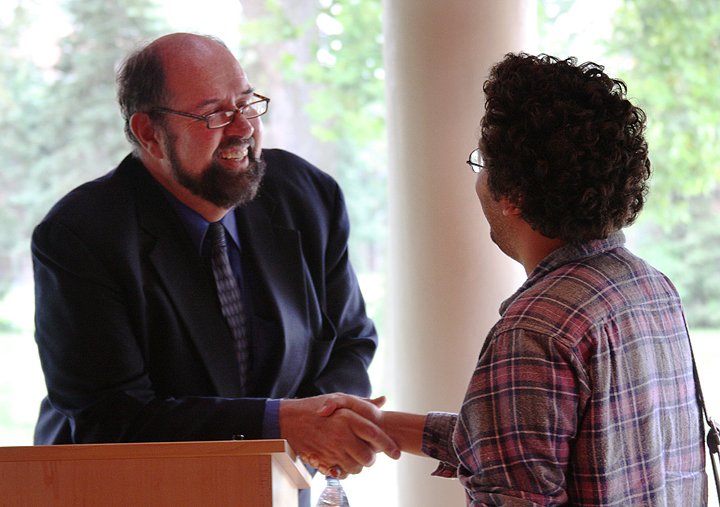
William Beeman shaking hands - Radka Slamova
What is public perception of Iran in America? Why do you disagree with it?
A: I think people see Iran as, it’s been characterized by a lot of people as a medieval backward country that’s ruled by repressive religious forces, and the picture also paints Iran as this very dark, gloomy place. And this is, you know, I didn’t say this explicitly in the talk, but the first thing you want to dispel is this notion. Because most Iranians live with economic and political difficulty, but for the most part the Iranians live a very happy life.
The idea, too, that the place is ruled by mullahs is wrong. During the time when Ayatollah Khomeini was established as the spiritual leader, yes indeed, they put a lot of clerics in positions of authority. But over the years they’ve proven to be not very good managers. … They’ve gradually been replaced by people who really knew what they were doing. So even in government, maybe 25 percent are still bona fide clerics, but the balance of the government is all now secular individuals, or people who stopped pretending that they’re clerics.
And getting to be a high-ranked cleric is also, I should say, not necessarily a guarantee that you’re going to be conservative. And what you find is that you go to the theological schools in the city of Qom. It’s a big capital with theological training, and some of those clerics, first of all they are just so smart, they have the equivalent of a Ph.D. in philosophy, and of course they know Arabic and they are skilled in argumentation. And many of them are very, very liberal, and very radical, and they also feel that they have the right to come out and just flatly criticize the government, which they do on a regular basis. So being a mullah, so to speak, is not a guarantee that you’re going to be conservative.
So both of those stereotypes that mullahs run the government is not correct, and the stereotype that mullahs are very conservative is not correct.
Q: What is the root of strained relations between Iran and America?
A: Well there are two sides to it. There are Iran’s problems with the United States. And these go way back. In Iranian thinking, the United States is an extension of Great Britain, and in the 19th century, Great Britain and Russia more or less divided up the country into spheres of influence, and the British had enormous influence over Iranian politics and the Iranian government. … In 1952, the Prime Minister then, Muhammad Musaddiq nationalized the Iranian oil company. The British were furious about the nationalization of oil, and the United States was afraid that Musaddiq was creating an unstable situation, so the U.S. staged a coup and brought the Shah back into power and deposed of Musaddiq. This was the first time the United States had acted really directly to deal with Iranian internal affairs. Then gradually over time the United States developed commercial relations with the Shah…The U.S. sold arms to Iran, lots of them, extensively for the defense of the country, but the Shah more or less used the increased military expenditure to develop a very strong defense force that also repressed the population of the country. So gradually there was opposition to the Shah because of his repressive tendencies, [and this was] also directed towards the United States for their support of the Shah…Then when the revolution finally came in ’78-’79, the United States made the terrible mistake of admitting the Shah to the United States for medical treatment. This was a big surprise to the Iranians, they didn’t know he was sick. And when they’d heard he had cancer and he was going to the U.S., they thought “uh oh, here we go again. They deposed the government in 1952 and restored the Shah, and now they’re bringing the Shah to the United States to make plans to depose the government again.” So they wanted to send their own doctors to New York to examine him to see if he really had cancer because they didn’t believe it. And then the U.S. refused. And that was the thing that touched off the takeover of the American embassy. The American embassy was taken over then, and many people in Washington view this as the most awful insult that has ever been leveled against the Unites States.
So the United States started to have trouble, serious trouble, at the time of the hostage crisis. The U.S. broke off diplomatic relations at that time with Iran and they’ve never restored them. Gradually, the U.S. imposed economic sanctions upon Iran, it’s not clear why …but these sanctions were renewed under Bill Clinton, and then finally under George W. Bush we had a whole neoconservative agenda that had been cooked up during the 1990s to affect regime change in all of the countries in the Middle East and get rid of the Iranian government.
And the U.S. tries to find ways to make up an excuse for attacking Iran that would be plausible to the American public. So once again they renewed the idea that Iran was supporting terrorists worldwide. And then they claimed that Iran was attacking the U.S. through proxies in Iraq. And finally they hit on this nuclear idea, as a justification for attacking Iran. So you can see that there’s a lot of bad blood between the two nations. And untangling 30 years of hostility is really, really tough. And a lot of it is actually quite emotional, not even substantive.
In point of fact, Iran hasn’t done anything to the United States, not anything, they haven’t done anything. I mean they kicked out the Shah, but it was their Shah. The charge that they were attacking the U.S. military in Iraq turned out to be completely unsubstantiated. They haven’t attacked Israel—they haven’t done anything to us. And yet the United States is still claiming that they are the most dangerous people in the world, the most dangerous nation on Earth. And Iran can point to several things that the United States has done to Iran.
Also what’s happened in the last ten years is that US-Iranian relations, they weren’t very good, but they were separate from U.S.-Israeli relations. The last decade, they’ve become united. And there’s a kind of formula—if you’re soft on Iran or friendly towards Iran, then you’re an enemy to Israel. It’s kind of amazing because we really should be pursuing separate tracks in my way of thinking. This affects American political life, because nobody, no politician can come out and say not even anything positive, or they can’t even say we should rethink our dealings with Iran—because then they get attacked by people who say they’re not supporting Israel, because in order to be a friend of Israel they have to be an implacable enemy of Iran.
Anyway, I know that sounds long, but it’s kind of a short litany of these grievances between the two.



 Posts


