Showing posts with label George Jahn. Show all posts

Friday, November 30, 2012

Fake AP Graph on Iran Exposes Israeli Fraud And IAEA Credulity

http://www.lobelog.com/fake-ap-graph-exposes-israeli-fraud-and-iaea-credulity/#more-15271


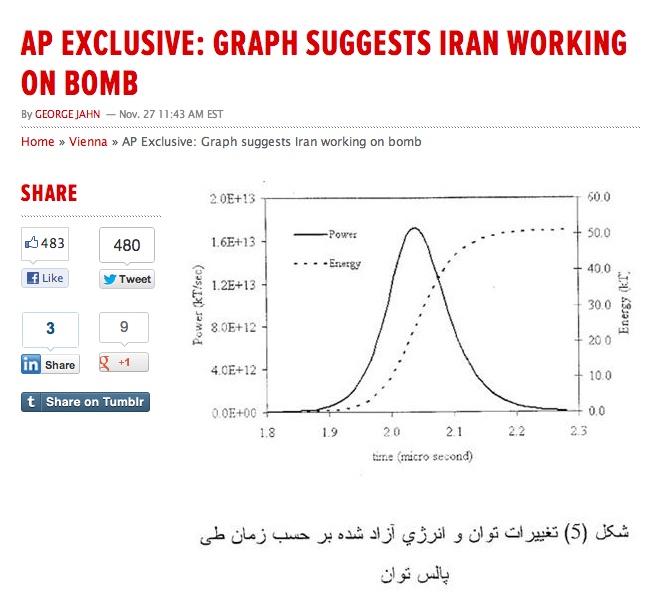
That Associated Press story displaying a graph alleged to be part of an Iranian computer simulation of a nuclear explosion — likely leaked by Israel with the intention of reinforcing the media narrative of covert Iranian work on nuclear weapons – raises serious questions about the International Atomic Energy Association’s (IAEA) claim that it has credible evidence of such modeling work by Iran.
The graph of the relationship between energy and power shown in the AP story has now been revealed to contain absurdly large errors indicating its fraudulence.
Those revelations indicate, in turn, that the IAEA based its publication of detailed allegations of nuclear weapons-related Iranian computer modeling on evidence that should have been rejected as having no credibility.
Former senior IAEA inspector Robert Kelley, who has challenged the accuracy of IAEA reporting on Iran, told Lobe Log in an e-mail that “It’s clear the graph has nothing to do with a nuclear bomb.”
“The pretty, symmetrical bell shaped curve at the bottom is not typical of a nuclear explosion but of some more idealized natural phenomena or mathematical equation,” he said. “Clearly it is a student example of how to perform integrals to which someone has attached some meaningless numbers.”
Nuclear physicists Yousaf Butt and Ferenc Dalnoki-Veress also pointed out that the graph depicted by AP is not only so rudimentary and crude that it could have been done by an undergraduate student, but is based on a fundamental error of mind-numbing proportions.
The graph shown in the AP story plots two curves, one of energy versus time, the other of power output versus time. But Butt and Dalnoki-Veress noted that the two curves are inconsistent. The peak level of power shown in the graph, they said, is nearly a million times too high.
After a quick look at the graph, the head of the Department of Physics and Astronomy at Cal State Sacramento, Dr. Hossein Partovi, observed, “[T]he total energy is more than four orders of magnitude (forty thousand times) smaller than the total integrated power that it must equal!” Essentially, the mismatch between the level of total energy and total power on the graph is “more than four orders of magnitude”, which Partovi explained means that the level of energy is 40,000 times too small in relation to the level of power.
One alert reader of the account of the debunking of the graph at the Mondoweiss blog cited further evidence supporting Kelley’s observation that the graph shown by AP was based on an another graph that had nothing to do with nuclear explosions.
The reader noted that the notation “kT” shown after “energy” on the right hand scale of the graph does not stand for “kilotons” as Jahn suggested, but “Boltzmann constant” (k) multiplied by temperature (T). The unit of tons, on the other hand, is always abbreviated with a lower case “t”, he pointed out, so kilotons would be denoted as “kt”.
The reader also stated that the “kT” product is used in physics as a scaling factor for energy values in molecular-scale systems, such as a microsecond laser pulse.
The evidence thus suggests that someone took a graph related to an entirely different problem and made changes to show a computer simulation of a 50 kiloton explosion. The dotted line on the graph leads the eye directly to the number 50 on the right-hand energy scale, which would lead most viewers to believe that it is the result of modeling a 50 kiloton nuclear explosion.
The graph was obviously not done by a real Iranian scientist — much less someone working in a top secret nuclear weapons research program — but by an amateur trying to simulate a graph that would be viewed, at least by non-specialists, as something a scientist might have drawn.
Although AP reporter George Jahn wrote that officials who provided the diagram did so “only on condition that they and their country not be named”, the country behind the graph is not much of a mystery.
Blogger Richard Silverstein has also provided a key piece of evidence indicating that the source of the graph was Israel’s intelligence agency, the Mossad. He reports that a “highly-placed Israeli source” told him the diagram “was stolen by the Mossad from an Iranian computer” using one of the various malware programs deployed against Iran.
That information links the graph in question to a longer stream of documents, supposedly obtained by Israeli intelligence from inside Iran’s nuclear program and then given to the IAEA over the past few years.  Former IAEA Secretary General Mohammed ElBaradei refers in his memoirs to documents provided by Israel in 2009 “purportedly showing that Iran had continued with nuclear weapons studies until at least 2007.” ElBaradei adds that the Agency’s “technical experts” had “raised numerous questions about the documents’ authenticity”, and suggested that US intelligence “did not buy the “evidence” put forward by Israel” in its 2007 National Intelligence Estimate.
Jahn’s story indicates that this and similar graphs were the basis for the IAEA’s publishing charges by two unnamed states that Iran had done computer modeling that the agency said could only have been about nuclear weapons.
Jahn cites a “senior diplomat who is considered neutral on the issue” as confirming that the graph accompanying his story was one of “a series of Iranian computer-generated models provided to the IAEA by the intelligences services of member nations.”
Those “computer generated models” were discussed in the November 2011 report, which referred to “[i]nformation provided to the Agency by two Member States relating to modelling [sic] studies alleged to have been conducted in 2008 and 2009 by Iran….”  The unnamed member states were alleging that the Iranian studies “involved the modelling [sic] of spherical geometries, consisting of components of the core of an HEU nuclear device subjected to shock compression, for their neutronic behaviour at high density, and a determination of the subsequent nuclear explosive yield.”
Nothing in that description of the alleged modeling is documented by the type of graph shown by the AP story.
The IAEA report concludes by saying, “The information also identifies models said to have been used in those studies and the results of these calculations, which the Agency has seen.”
In other words, the only evidence that the IAEA had actually seen was the graphs of the alleged computer modeling, of which the graph shown in the AP story is alleged to be an example. But the fact that data on that graph has been credibly shown to be off by four orders of magnitude suggests that the Israeli claim of Iranian computer modeling of “components of the core of an HEU nuclear device subjected to shock compression” was completely fabricated.
Former IAEA Inspector Kelley also told Lobe Log that “We can only hope that the claim that the IAEA has relied on this crude hoax is false. Otherwise their credibility has been shattered.”
- Gareth Porter, an investigative historian and journalist specialising in U.S. national security policy, received the UK-based Gellhorn Prize for journalism for 2011 for articles on the U.S. war in Afghanistan.

Thursday, February 23, 2012

Porter--Iran Holds Up Access to Parchin for Better IAEA Deal (IPS)

Commentary by William O. Beeman: The recent IAEA inspection team in Iran declared that their mission had been a "failure" largely because they were not allowed to visit the Parchin military base. Historian and journalist Dr. Gareth Porter analyzes this incident pointing out that Parchin had been inspected before, that the IAEA exceeded its mission, and that, in general, this mission was very different than characterized by the IAEA. In short, the inability of the IAEA to get access to Parchin does NOT in any way prove that Iran has a nuclear weapons program.There is still no evidence whatever that Iran has a program to manufacture nuclear weapons.


Iran Holds Up Access to Parchin for Better IAEA Deal

Analysis by Gareth Porter*


WASHINGTON, Feb 23 (IPS) - The failure of a mission by the International Atomic Energy Agency (IAEA) to get Iranian permission to visit a military testing site mentioned in its latest report has been interpreted in media coverage as a stall to avoid the discovery of confirming evidence of past work on nuclear weapons.
But the history of Iranian cooperation with the IAEA on carrying out inspections at the Parchin military testing centre, as well as a previous IAEA-Iran work programme agreement, suggests that Iran is keeping permission for such a visit as bargaining leverage to negotiate a better deal with the agency.

The IAEA statement Wednesday emphasised the fact that the mission to Tehran had been denied permission to visit the site at Parchin. That prompted Associated Press correspondent in Vienna George Jahn to call Iran's refusal to agree to an IAEA visit to Parchin "stonewalling" and evidence of "hard line resistance" to international pressure on its nuclear programme.

International Herald Tribune blogger Harvey Morris wrote that Iran's strategy was to "play for time".

But access to Parchin was discussed as part of broader negotiations on what the IAEA statement called a "document facilitating the clarification of unresolved issues" in regard to "possible military dimensions" of Iran's nuclear program. The negotiations were focused on what cooperation the IAEA is demanding and what the agency is ready to offer in return for that cooperation.

Judging from past negotiations between Iran and the IAEA, Iran is ready to offer access to Parchin as well as other sites requested by the agency as part of an agreement under which the IAEA would stop accusing Iran of carrying out covert nuclear weapons experiments.

The IAEA's position in the negotiations was revealed by the AP's Jahn, who reported that the agency mission had hoped to get Iranian agreement to meetings with "scientists suspected of working on the alleged weapons program" and to "inspect documents related to nuclear weapons work".

The September 2008 IAEA report said the agency had "proposed discussions with Iranian experts on the contents of the engineering reports (on the Shahab-3 missile) examining in detail modeling studies…."

Iran has rejected such demands as threatening its legitimate national security interests, in violation of the IAEA statute.

The scientists that the agency is demanding to see are publicly known officials of Iran's military research institutions. Even before Israel had begun assassinating Iranian scientists, Iran had made it clear it will not give the IAEA physical access to any individual scientists.

The IAEA wants to visit a specific site at Parchin because of information from an unnamed member state, cited in its November 2011 report, that Iran had "constructed a large explosives containment vessel in which to conduct hydrodynamic experiments" – tests of nuclear weapons designs without the use of fissile material.

The report said the construction had been carried out at Parchin military complex in 2000 and that the IAEA had satellite imagery that was "consistent with" that information, meaning only that there were structures that could have housed such a vessel at Parchin in 2000.

The previous history of IAEA inspections at Parchin make it clear, however, that Iran knew it had nothing to hide at Parchin after 2000.

In 2004, John Bolton, the point man in the George W. Bush administration on Iran, who coordinated closely with Israel, charged that satellite imagery showed a bunker at Parchin appropriate for large-scale explosives tests such as those needed to detonate a bomb that would use a neutron trigger.

Bolton put heavy pressure on the IAEA to carry out an investigation at Parchin. A few months later, Tehran agreed to allow the agency to select any five buildings and their surroundings to investigate freely.

That gave U.S. and Israeli intelligence, as well as IAEA experts, an opportunity for which they would not have dreamed of asking: they could scan satellite imagery of the entire Parchin complex for anything that could possibly suggest work on a nuclear weapon, including a containment vessel for hydrodynamic testing, and demand to inspect that building and the grounds around it at their leisure.

In January 2005, an IAEA team visited Parchin and investigated the five areas they had chosen, taking environmental samples, but found nothing suspicious. In November 2005, Iran allowed the IAEA to do the same thing all over again on five more buildings of its own choice.

The Iranian military and nuclear establishment would never have agreed to such terms for IAEA inspection missions at Parchin - not once but twice - if they had been concealing a hydrodynamic test facility at the base.

Other information suggests that no such vessel ever existed at Parchin. The November report claimed the IAEA had obtained information on the dimensions of the containment vessel from the publication of a foreign expert identified as someone who worked "in the nuclear weapons program of the country of his origin".

That was a reference to Vlachyslav Danilenko, a Ukrainian scientist who has acknowledged having lectured in Iran on theoretical physics and having helped the country build a cylinder for production of nano-diamonds, which was his research specialty. However, Danilenko has firmly denied ever having done any work related to nuclear weapons.

The claim that the dimensions of the putative bomb test chamber at Parchin could be gleaned from a publication by Danilenko is implausible.

The report said the bomb containment chamber at Parchin was "designed to contain the detonation of 70 kilograms of high explosives". Danilenko's patented 1992 design for a cylinder for nano-diamond production, however, was built to contain only 10 kg of explosives.

Former IAEA weapons inspector and nuclear weapons expert Robert Kelley has pointed out, moreover, that a container for only 70 kg of explosives could not possibly have been used for hydrodynamic testing of a nuclear weapon design.

The negotiations on a "framework" for Iran's cooperation with the IAEA recall the negotiation of a "work programme" in August 2007 aimed at resolving a series of issues on which the IAEA Safeguards Department suspected links to nuclear weapons. The issues included experiments involving the extraction of polonium-210, plutonium experiments and possible military control of the Gchine uranium mine.

In previous years, Iran had failed to provide sufficient information to overcome those suspicions. But after the negotiation of the "work programme", Iran began to move with dispatch to provide documentation aimed at clearing up the six remaining issues.

The IAEA acknowledged that all six of the issues had been effectively resolved in two reports in late 2007 and early 2008.

The reason for the dramatic change in cooperation was simple: the IAEA had pledged that, in return for Iran's resolving the six issues, "the implementation of safeguards in Iran will be conducted in a routine manner." That was seen as a significant step toward finally getting a clean bill of health from the agency.

But the IAEA instead then began focusing its questioning entirely on the purported Iranian documents of unknown origin and doubtful authenticity which the IAEA called the "alleged studies".

*Gareth Porter is an investigative historian and journalist specialising in U.S. national security policy. The paperback edition of his latest book, "Perils of Dominance: Imbalance of Power and the Road to War in Vietnam", was published in 2006.

(END/2012)